Tuesday, 2 June 2015
Ethel Winifred White.
My Grandma Ethel Winifred White had been born on 13th May 1881. She is registered as ‘Whyte’
some 41 days after her birth – just before the family would have been fined for non-registration.
Younger sister Dora (married name Dora Silk) is also registered as ‘Whyte’ in 1883. There is no trace
of a marriage of their parents (as yet?), though they were together for well over thirty years. Did the
person registering them (and paying) not know the father’s surname well?
Their father was Ethelbert Ernest White, a master fishmonger. In these days when supermarkets
are taking over and the specialist, trained at selecting and purchasing, handling, gutting, boning,
filleting, displaying, merchandising and selling their product is becoming increasingly rare. To anyone
who felt that the job was ‘only’ a fishmonger, they were one of the earliest guilds established in the
City of London, granted a Royal Charter by Edward I and known to have already been in existence for
at least 100 years prior to that charter. The Company ranks fourth in the order of precedence of the
Livery Companies, making it one of the Great Twelve City Livery Companies.
Ethelbert is a White ‘family’ name. Ethel’s Grandfather was Samuel Ethelbert White. He was born
about 1828 in Canterbury. A chorister there at six, he becomes a supervisor for Her Majesty’s Excise.
Samuel Ethelbert married Catherine Veri Vlieland (daughter of Jerome Nicholas) in Plea Norwich,
Norfolk on the 2nd of August 1855. ( Thus the White family feature on the Vlieland blog)
Unlike his ancestors, Samuel Ethelbert seemingly did not stay in one place for long. His job as an
Inland Revenue Officer of the Excise regularly moved him; sometimes on promotion. Caledonian
Mercury (Edinburgh, Scotland), Jan 26, 1857 reports under "Home Intelligence - Inland Revenue
Department" that “Samuel Ethelbert White, officer of Gye-Ryde has been appointed on promotion to be officer of Southampton forth
division - Isle of White collection". The 1861 census shows them at home with a live in servant.
Apart from moves not picked up by the census, they had gone from Norwich to Southampton and on to
Winchester, Hampshire by the time their third child, Bertha is born in 1860. They are still at
Winchester for the birth of Ethelbert Ernest (on 2
nd September 1862), William Blomfield on the
last day of 1864 and finally another Samuel (Athelstan) in 1870.
The family have again moved (to Waterside, Jew's Row, Wandsworth London) by the time of the 1871
census. Some time between then and son Ethelbert’s enrolment at Kings School in 1876 the family
returned to Samuel’s birthplace, Canterbury. They were still there when he was initiated as a member
of Augustine Lodge No 972 in Canterbury on 12th December 1878 at the age of 50.
According to the records, the young Ethelbert was living in Canterbury at 6 Westgate Street,
Canterbury in 1876 and was sent by his parents to what is understood to be the oldest school in
England (Leach – Hist Med Schools - Methuen 1915), The King's School. St. Augustine established a
school shortly after his arrival in Canterbury in 597 and it is from this that some claim The King’s
School grew - and so thus it flourished in Saxon times. The discipline in the era when Ethelbert
attended is described by one source as ‘vicious’.
The school archivist and register confirm that Ethelbert was there for a single year, some three years
after the infamous disciplinarian Reverend Mitchinson left. Until the Education Act of 1870 education
was limited to fee paying schools. Now a ‘free’ education was possible (for younger children) but
Ethelbert, well past the minimum age to leave school, attends just such a fee paying school. In the
1890s tuition fees were £20 p.a. and had, according to the archivist, probably not changed much. In
case this does not seem a lot, a cottage would cost about £50 to purchase. Boarders paid additional
fees of course, but Ethelbert was seemingly a dayboy. As he was not a scholar, his father would have
had to pay these fees.
He joined in May 1876 and left in April 1877. He was fourteen and a half. In case this seems young
to us, few children stayed on at school until ten and the minimum school leaving age (of eleven) was
not set until 1880 when education from 5-10 became compulsory; the leaving age not being raised to
12 until 1899). Ethelbert did not join the school until he was thirteen. The list of his ‘peers’, in
summer term 1876, most of whom stayed on even longer, is formidable!
He leaves the school in April 1877 and in June he is shown buying four brick built cottages, No. 1-4
Caledon Terrace, Nunnery Fields at auction for prices from £128 to £142 each (others, not these, are
shown as “bought by agents for”) and two years later he is shown as an agent being warned that other
properties have defective drainage by the Canterbury General Purposes Committee. the 1881 census.
By then they have moved, back to London, to 9 Alfred St Lucas Terrace, Bow, Stratford-le-Bow.
Ethelbert continues to stay with them; a commercial clerk. He soon has children and a new career.
The family are at 50 Iliffe Street Newington by the 1891 census. By 1901 they are at 171 Manor
Place; not far away. It would seem that Ethelbert was not a sensible name for a successful tradesman
to admit to. By the 1908, 1910 and 1912 Kellys Directories and subsequent voters lists he is shown as
Edward White but in the 1911 census he is Ernest White (his second name) all at the same 171 Manor
Place address. He has still christened his son Cecil Ethelbert White in 1899; though he is now known
as Jack (or John). Ethel Winifred begins her working life in the fish shop, as did two of her sisters.
Later on, in Croydon, two of the brothers would, themselves, own a fish shop not far away from, by
then widowed, Ethel Winifred Dunn and her family…
There are nine children, with Ethel and Dora the eldest plus Samuel (1884), Frederick (1888), William
(1890), Robert (1891), Kate (1893), Eva (1896) and Cecil Ethelbert. There is, so far, no trace of their
marriage and her age and place of birth seem different to that shown in the censuses. Experts suggest
that very few people ‘cohabited’ at that stage and even a subsequent marriage would not have
legitimised an earlier child until 1926. My father used to say that he understood that his grandfather
had been disinherited for marrying a barmaid. Was that Ethelbert and Kate? A grandson reports him
as a ‘character’ - a ‘Del Boy’ type – always coming home with strange things (like monkeys!) Certainly
Ethelbert’s profession was not one which I have traced to any other preceding family member.
In the birth certificates of the children his wife is shown as Kate Rycroft; not that usual a name. The
census records her as born about 1863 in Tunbridge Wells – not a record I have found; not all still
were. There are births of male children to Nelson Rycroft (JP) at Sevenoaks – only ten miles away but,
perhaps more likely, a family in Broom Hill, Southborough, immediately to the north of Tunbridge Wells
(within its district). Up to eight percent of births went unrecorded at that time and it is possible that
she is recorded neither there nor in the immediately following censuses. The family in ‘Tunbridge’ are
John, steward to Sir D Salomons M P, his wife Rebecca and son John D – the gardener, age 26, who
had been born there. They are the only Rycrofts shown in all Kent in the 1861 census. Their address,
then, is shown as Modest Corner Southborough, Tunbridge Wells. Are they Kate’s family?
The fact that both son John and daughter Rachel are registered suggests not – as does the age (over
50) of Rebecca, and the fact that Rachel is described as the only direct heir in her Father’s will. The
only other Rycroft in Kent in 1871 is Kitty a 79 year old boarder at Common Grove Lodge
Southborough. The name Kitty and closeness of a ‘Rycroft’ family could be a clue... There is another
John Rycroft in Clapham born about 1827, who like steward/bailiff John is born in Bedfordshire with a
son born in Tunbridge Wells. Are they linked to this John – or ‘our Kate’? This son Alfred is also
registered. Why can we find no trace of Kate’s birth, family or marriage?
Father Samuel Ethelbert’s death is registered in Fulham in 1886. He had made a fresh will only the
previous year when he also left the Masons. The family story that Ethelbert Ernest White was
‘disinherited’ is obviously one of those family ‘stories’ as, in Samuel’s will obtained from the probate
office, he is left a house in “Ryde Street in the Parish of Saint Dunstans in the City and Borough of Canterbury”. (In 1902
Samuel’s brother Adolphus (musician in ordinary to Queen Victoria) leaves him two further houses).
William Blomfield and Samuel Athelstan, his brothers, are also left a house in the same street. Bertha
Susannah White (spinster), his second daughter, is left number one Ryde Street. Although the houses
are no longer there, pictures of the street in the 1940’s show Ryde Street as a terrace of six houses
numbered one to six. The pictures were taken before the demolition of the properties by the council
(whilst they were still occupied). Since I have signed a confidentiality agreement confirming that I will
neither publish nor copy nor provide copies, I can simply confirm that from the front at street level
they simply looked like a terrace of brick/white painted, tiled roof cottages (much like many normal
early Victorian ones) BUT from the back and high up it was obvious that five and six were later
additions with a separate pitched roof (and numbers 5-6 were not even rendered at the back). It
seems clear that Samuel Ethelbert owned the whole original terrace (numbers 1-4) and we know from
the surveyors orders for water to be laid on, in May 1876, that these four were almost the last
properties in Canterbury to gain access to water..
In addition his eldest son Charles Ethelbert is left his Fathers old residence at 6 Blackfriars (currently
tenanted by William Jennings Esquire) together with his main address at 36 Chesilton Road, Munster
Place Fulham. His wife also receives his A shares in the Civil Service Supply Association Ltd and the
balance in his Inland Revenue Building Society Account and, of course, all the rents and revenues for
the rest of her life. After his wife’s death these are also to go to daughter Bertha. Bertha, however, is
not to inherit for almost thirty years – more than twenty after her subsequent marriage. At the time of
the 1901 census Bertha, her husband and their daughter Helen Bertha age 21 are living in Putney (an
area they have been in since the birth of their daughter). Helen Bertha marries Leslie Miller in 1914.
Samuel was, perhaps, ‘forward looking’ for his time. Ensuring provision for (seemingly) all his children
(one daughter was married and thus not provided for); he also left provision for his spouse for the rest
of her life. He does not leave her either a lump sum or a property that might be ‘transferred’ to a
second husband but sets aside funds to allow her to receive interest for life; the funds reverting to his
daughter after Catherine’s death. Just as it had been ‘fashionable’ for the middle classes to fix a
settlement on their female children to ensure that they were not left penniless by the death of their
‘man’ and thus forced to throw themselves upon the mercy of their relatives at such time.
Older Daughter Bessy (Elizabeth Mary Mills Annie) was not mentioned in the will. She was shown in
the 1881 census living at 9 Alfred St Lucas Terrace, Bow. It had long been the tradition of the ‘old
families of England’ that the eldest son received the ‘estate’ (Charles had gained the main residence)
unmarried daughters were usually supported through their lives through trusts (Bertha received a
house like her brothers and income after her Mothers death) and that married women received
nothing. Elizabeth had, indeed, got married to Edgar Wallington in 1884.
Including the six houses, the shares and the building society sums, his estate is valued at £489-13-6.
‘Inheritance Tax’ was first introduced as a tax on estates in England and Wales over a certain value
from 1796, (then called legacy, succession and estate duties). The value changed over time and the
scope of estate duty was extended. Under the 1857 Succession Duty Act estates worth over £20 were
taxable (which may illustrate the size of the estate here; bearing in mind that, in the year that Samuel
Ethelbert died, a skilled worker could make £2-3 per week, the annual pay of a housemaid was £10-12
and a third of households survived on under 25s a week). Duty was, however, rarely collected on
estates valued under £1,500 (before the 1894 budget reforms).
Catherine survives him for nearly thirty years. The houses in Ryde Street do not stay in the family for
that long. In 1907 the following advertisement appears in the Canterbury papers – “Four empty freehold
cottages, Ryde Street, St. Dunstan's Canterbury, what offers. Contact Lepine, 43 Broad Street, Canterbury”. The street, in the St
Dunstans area of the city is a historic suburb centred on the route towards London.
The 1911 census, the first one filled in by the head of household and the first one detailing years of
marriage and numbers of children shows ‘Ernest’, wife Kate (and four of their children still at home)
living at 171 Manor Place Southwark (one in a row of combined ‘shops and houses’ with a separate flat
at each. Mrs Hill and one other female live in the separate flat and the Whites have six rooms and a
fish shop). They are ‘31 years married’ with 10 children (two are deceased). Does the ‘family tale’
explain why Kate’s story is ‘unclear’?
Thirty years earlier, in the 1881, census there is no sign of Kate at the address, 30 Wincott Street,
(London SE 11) at which she is to give birth a month later. Spouse Ethelbert is shown shown as single
(living with parents) at time of 1881 census (though Kate is described as ‘Kate Whyte’ in Ethel’s birth
certificate only a month later). He is with Kate and 9 year old child (and other children) at the 1891
census (close by in Southwark) ten years later.
The 1920 Hughes Business Directory still shows “White E fishmonger 171 Manor Place, SE17”. His first wife, Kate
has died at home in the presence of her husband on 23rd November 1913 from a “cerebral
haemorrhage and coma” aged, according to the death certificate, ‘53’ and he has married again at the
Southwark Register Office on the first of June 1920.
Emily Rosina Miriam Martin is a widow and, at 43, some 14 years younger than her widower husband.
The marriage certificate shows her as a “Housekeeper (Domestic)” and her father as (William) George
Elston, a vellum binder. Grandfather William Elston was a much travelled and ‘adaptable’ man. The
1851 census shows him as a bricklayer and fishmonger and his children are born in Coleyweston,
Rutland, Louth, Northampton and Sheffield. According to another treeholder Grandmother Emily Close
was daughter of Laetitia Elizabeth Shield, apparently known as Eliza, born in Kensington at a time
when when her father was vicar or rector of Collyweston and who married a ‘slater’ in Collyweston. (At
least one interpreter of his handwriting has ‘translated’ his child as ‘Emery’ and not Emily!)
Not surprisingly with his shop downstairs curing its own fish, the smell was ‘strong’. The shop sold
raw fish and cooked fish and chips (the latter cut on a fascinating old machine). In early 2010 when
Google maps first pictured it, half the old, decaying parade was boarded up. A shop called ‘Bob
White’s’ has earlier opened round the corner from where Ethelbert’s was. It stays open for many
years; first shown as an ‘eel and pie’ shop in the commercial directories of the ‘40’s at 11 Kennington
Lane SE11; later as a fish and chip shop.
The 1926 Post Office Directory still shows him as “White, Edward” of 171 Manor Place Walworth SE17.
He is 65 when he dies of myocarditis and chronic bronchitis. The informant is his son from his first
marriage, Cecil Ethelbert White, now living at 122 Thorncliffe Road, Clapham Park London SW5. In the
certificate Cecil shows his fathers middle name as ‘Edward’ – the name used in the Trade Directories.
(His birth certificate shows “Ethelbert E“). He spent his last few days in King's College Hospital,
Camberwell. There is no trace of a will. Despite being left property by father and uncle, probate is not
needed for Ethelbert’s estate. Did his second wife inherit? Emily dies four years later. There is no
probate for her either. I was told that one of the children receives much of his (mostly bamboo)
furniture.


Monday, 1 June 2015
Emily (Elston)Martin
We received this email.
I have been trying to research my great grandmother Emily (Elston) Martin who married Ethelbert White and lived at Manor Place London.
Please see photos below of Manor Place taken earlier this year, I thought they may be of interest.
My understanding is that this site is soon to be demolished, like much of London these buildings are being pulled down to make way for luxury apartments.
If you have any information or photos of Emily Ethelbert we would love to see them. Unfortunately our grandmother would never speak of her mother nor did she keep any photos so we have no idea what she looked like or indeed what she was like.
The only information that we have found is that she was widowed and then married Ethelbert White. Following Ethelbert's death she then went on to commit suicide at Manor Place in 1931, all a bit of a sad story.


And of course when the White family is involved we ask Ray for advice .
he informed us
The 1920 Hughes Business Directory still shows “White E fishmonger 171 Manor Place, SE17”. His first wife, Kate has died at home in the presence of her husband on 23rd November 1913 from a “cerebral haemorrhage and coma” aged, according to the death certificate, ‘53’ and he has married again at the Southwark Register Office on the first of June 1920. Emily Rosina Miriam Martin is a widow and, at 43, some 14 years younger than her widower husband. The marriage certificate shows her as a “Housekeeper (Domestic)” and her father as (William) George Elston, a vellum binder.

Grandfather William Elston was a much travelled and ‘adaptable’ man. The 1851 census shows him as a bricklayer and fishmonger and his children are born in Coleyweston, Rutland, Louth, Northampton and Sheffield. According to another treeholder Grandmother Emily Close was daughter of Laetitia Elizabeth Shield, apparently known as Eliza, born in Kensington at a time when when her father was vicar or rector of Collyweston and who married a ‘slater’ in Collyweston. (At least one interpreter of his handwriting has ‘translated’ his child as ‘Emery’ and not Emily!)
He wrote back that he did not know much more than this and that his great grandfather was a character .
He has hisfamilytree on Ancestry and here is the adress .
My family tree is on Ancestry and Ethelbert Ernest is:
http://trees.ancestry.co.uk/tree/70904764/person/38220728248
I have been trying to research my great grandmother Emily (Elston) Martin who married Ethelbert White and lived at Manor Place London.
Please see photos below of Manor Place taken earlier this year, I thought they may be of interest.
My understanding is that this site is soon to be demolished, like much of London these buildings are being pulled down to make way for luxury apartments.
If you have any information or photos of Emily Ethelbert we would love to see them. Unfortunately our grandmother would never speak of her mother nor did she keep any photos so we have no idea what she looked like or indeed what she was like.
The only information that we have found is that she was widowed and then married Ethelbert White. Following Ethelbert's death she then went on to commit suicide at Manor Place in 1931, all a bit of a sad story.
And of course when the White family is involved we ask Ray for advice .
he informed us
The 1920 Hughes Business Directory still shows “White E fishmonger 171 Manor Place, SE17”. His first wife, Kate has died at home in the presence of her husband on 23rd November 1913 from a “cerebral haemorrhage and coma” aged, according to the death certificate, ‘53’ and he has married again at the Southwark Register Office on the first of June 1920. Emily Rosina Miriam Martin is a widow and, at 43, some 14 years younger than her widower husband. The marriage certificate shows her as a “Housekeeper (Domestic)” and her father as (William) George Elston, a vellum binder.
Grandfather William Elston was a much travelled and ‘adaptable’ man. The 1851 census shows him as a bricklayer and fishmonger and his children are born in Coleyweston, Rutland, Louth, Northampton and Sheffield. According to another treeholder Grandmother Emily Close was daughter of Laetitia Elizabeth Shield, apparently known as Eliza, born in Kensington at a time when when her father was vicar or rector of Collyweston and who married a ‘slater’ in Collyweston. (At least one interpreter of his handwriting has ‘translated’ his child as ‘Emery’ and not Emily!)
He wrote back that he did not know much more than this and that his great grandfather was a character .
He has hisfamilytree on Ancestry and here is the adress .
My family tree is on Ancestry and Ethelbert Ernest is:
http://trees.ancestry.co.uk/tree/70904764/person/38220728248
Sunday, 31 May 2015
the will of Elizabeth Samworth formerly Lefevre


there are silver spoons ,forks a teapot and stand ,but no plate as far as I can tell.
Saturday, 30 May 2015
The plate
After all these years you start all over again after youre attention is drawn to something from years ago, for instance with the plate.You notice the little flowers ,but not the crown and dove and letter in the middle of this plate
First you try and find a crest with a dove over a crown.
It must look something like this.So you google and find a crown and a dove.


But this on the picture is not a real crest. It is a fancy one and you can order it to be painted on your furniture.
So we still have to find the owner of the crest.Sometimes we find a dove and sometimes a crown but not together and like on the plate.
Then you start your research again.
Maybe it was an F under the crown and dove and was it like the crest on the plate an heirloom of the Lefebures .(Lefevres)
How was that story again ????? It was the widow of Charles Lefebure ,the actress Elizabeth Bride,
This widow of Charles Lefebure remarried John Samworth.
She became that way the stepmother of Frances Elisabeth Samworth .
Who married Jerome Nicholas Vlieland and inherited some of her things and maybe the plate as well.
So that means looking in the National Archives for the will of Elizabeth and hoping a plate is mentioned there.
And yes we found the will.
This story continues tomorrow.

First you try and find a crest with a dove over a crown.
It must look something like this.So you google and find a crown and a dove.

But this on the picture is not a real crest. It is a fancy one and you can order it to be painted on your furniture.
So we still have to find the owner of the crest.Sometimes we find a dove and sometimes a crown but not together and like on the plate.
Then you start your research again.
Maybe it was an F under the crown and dove and was it like the crest on the plate an heirloom of the Lefebures .(Lefevres)
How was that story again ????? It was the widow of Charles Lefebure ,the actress Elizabeth Bride,
This widow of Charles Lefebure remarried John Samworth.
She became that way the stepmother of Frances Elisabeth Samworth .
Who married Jerome Nicholas Vlieland and inherited some of her things and maybe the plate as well.
So that means looking in the National Archives for the will of Elizabeth and hoping a plate is mentioned there.
And yes we found the will.
This story continues tomorrow.
Thursday, 28 May 2015
The stork, the seal and the plate
We mentioned it before the Vlieland descendants are genealogy detectives.
So every once and a while the stork , the plate and the seal surface .
Why ? because we still do not know everything about it.

And one of the detectives said could it be the ceramic plate of which we do not know much ?

the reference to "a handsome piece of plate" does not refer to a plate as such as in dinner plate necessary. Plate is a 19th century term used when referring to silver plate as in "Sheffield silver plate". A thin layer of silver electroplated onto another metal. Probably it would have been a plate but could have been anything I think probably this handsome plate referred to would have been a commemorative piece with an inscription on it from his grateful parishioners. Such engraved things were quite the fashion at that time. The only plate I know of in silver was one my cousins once referred too. She said her Uncle (Charles Vlieland of Exeter) had a large silver plate with a stork engraved on it which she believed was family.
And yes there is the stork again .
We still do not know where the stork comes from .Is it from the city of The Hague in Holland who has a coat of arms with the stork? Is it a family coat of arms likethe Stork family.To remember a birth?
it is also on a spoon
here the story of the Spoon with the stork.
So that was the end of that investigation .
and then there was a seal


he Dutch center for heraldry found out is was the crest of the Lefevre family of Guernsey.
So how did this seal ended up in the Vlieland family who could it belong to?
Well the connection with the Lefebures as the original name of the Lefevres is from Elisabeth Lefebures.
She had a will dated 1824 and proved 1827.
She married on 8 December 1808 at St Alphage Church Greenwich when she was 48 years old with John Samworth of Greenwich Kent.
She is described as late Elizabeth Lefebure widow
This John Samworth had a son by his first wife born in 1790.
This son had a daughter Frances Elizabeth Samworth in 1825 and she married Jerome Nicholas Vlieland the younger or the vicar as we say.
The seal must have past down the family to her and with the passage of time through the Vlieland family.
So that was the story of the seal .
So maybe after all these years someone can tell us more and otherwise we will be hunting for many years to come.
So every once and a while the stork , the plate and the seal surface .
Why ? because we still do not know everything about it.

And one of the detectives said could it be the ceramic plate of which we do not know much ?


the reference to "a handsome piece of plate" does not refer to a plate as such as in dinner plate necessary. Plate is a 19th century term used when referring to silver plate as in "Sheffield silver plate". A thin layer of silver electroplated onto another metal. Probably it would have been a plate but could have been anything I think probably this handsome plate referred to would have been a commemorative piece with an inscription on it from his grateful parishioners. Such engraved things were quite the fashion at that time. The only plate I know of in silver was one my cousins once referred too. She said her Uncle (Charles Vlieland of Exeter) had a large silver plate with a stork engraved on it which she believed was family.
And yes there is the stork again .
We still do not know where the stork comes from .Is it from the city of The Hague in Holland who has a coat of arms with the stork? Is it a family coat of arms likethe Stork family.To remember a birth?
it is also on a spoon
here the story of the Spoon with the stork.
An interesting thing happened yesterday. I was looking for something in the depths of a cupboard when I found some silverware which belonged to my grandmother, I have not looked at these items for years, well I had a quick look through and spotted a spoon with a monogram on the handle, the monogram was a stork!! I suddenly thought I wonder if this is the same monogram that is spoken about in the letter.
The letter Charles James Vlieland wrote to Holland and in which he says there was a family crest
Certain of my relatives think it was a stork with a snake in its bill. This stork does not carry the eel in it's beak but has it's foot raised on a cross, it is also standing on a twisted rope style ground.
One family member mailed

One family member mailed

So here is the stork and of course there is a back on this spoon


Then another family member explains this back side .The duty mark. This is the monarchs head, in this case George III. This was to show duty had been paid to the crown on this spoon before it has its assay mark struck. In this case he is what is called “in cameo” as he has an oval mount around him.
Then the lion is what is called passant (standing on 3 legs) also he is not looking ahead of himself but at you. Hard to tell I know but if you saw one looking ahead you would see how it differs.
The date letter is a Roman uppercase K in a cartouche that is flat at the top with slants either side and a shield shape at the bottom.
Every year and City has variations of these things, the date letter especially, as it can be one of many fonts with a different surround.
The only place that has all these ingredients at one time is London 1805-1806.
And this is what the first familymember had discovered as well
The makers marks of
Thomas Wallis II

as you can see here as well .So we know it is made in 1805 in London by Thomas Wallis .
Then the lion is what is called passant (standing on 3 legs) also he is not looking ahead of himself but at you. Hard to tell I know but if you saw one looking ahead you would see how it differs.
The date letter is a Roman uppercase K in a cartouche that is flat at the top with slants either side and a shield shape at the bottom.
Every year and City has variations of these things, the date letter especially, as it can be one of many fonts with a different surround.
The only place that has all these ingredients at one time is London 1805-1806.
And this is what the first familymember had discovered as well
The makers marks of
Thomas Wallis II

as you can see here as well .So we know it is made in 1805 in London by Thomas Wallis .
And maybe it was a present for someone born in 1805
Then the stork
The third familymember asked help at the Dutch heraldic society about the stork.And they explained
It is possible Anglo-Saxon, as the stork with the knob cross under his footand it stands on a knot .
This is a so-called crest In the English part of the world it can be used separately without helmet marks on the weapon., As a kind of synecdoche.
Very heraldic and maybe quite understandable but it does not make sense for this familymember .
But we can conclude that it is British and about the time Jerome was born obviously we have no way of knowing if this was part of the Vlieland silver but it is nice to think it could be.
The third familymember asked help at the Dutch heraldic society about the stork.And they explained
It is possible Anglo-Saxon, as the stork with the knob cross under his footand it stands on a knot .
This is a so-called crest In the English part of the world it can be used separately without helmet marks on the weapon., As a kind of synecdoche.
Very heraldic and maybe quite understandable but it does not make sense for this familymember .
But we can conclude that it is British and about the time Jerome was born obviously we have no way of knowing if this was part of the Vlieland silver but it is nice to think it could be.
So that was the end of that investigation .
and then there was a seal


he Dutch center for heraldry found out is was the crest of the Lefevre family of Guernsey.
So how did this seal ended up in the Vlieland family who could it belong to?
Well the connection with the Lefebures as the original name of the Lefevres is from Elisabeth Lefebures.
She had a will dated 1824 and proved 1827.
She married on 8 December 1808 at St Alphage Church Greenwich when she was 48 years old with John Samworth of Greenwich Kent.
She is described as late Elizabeth Lefebure widow
This John Samworth had a son by his first wife born in 1790.
This son had a daughter Frances Elizabeth Samworth in 1825 and she married Jerome Nicholas Vlieland the younger or the vicar as we say.
The seal must have past down the family to her and with the passage of time through the Vlieland family.
So that was the story of the seal .
So maybe after all these years someone can tell us more and otherwise we will be hunting for many years to come.
Sunday, 24 May 2015
Daughter and wife

Friday, 22 May 2015

Thursday, 21 May 2015
Kings College

Wednesday, 20 May 2015
accident

Friday, 15 May 2015

Thursday, 14 May 2015
Clara Christina Vlieland

Wedding of Clara Christina Vlieland and Pieter van der Vliedt June 10 1725 Alkmaar .
from this wedding.
If we look at Clara Christina Vlieland and her family we se some familiar names.
Johannes born 13/06/1726 (named after her father)
Willemijntje 03/09/1727 (named after her mother)
Johannes Henricus 17/07/1729
Willem 13/12/1731
Cornelis19/01/1734
Hillegonda 15-09-1737 .(Named after her grandmother)
She died CLARA VLIELAND (OVERLEDENE)
Plaats /place
Alkmaar
Bron /source
Doop-, Trouw- En Begraafregister
Periode /time
1748-1830
Begraven buried (Grote Kerk)
Inventarisnummer /inventory
42
Soort registratie /registration type
begraafakte /death certificate
Aktenummer
35252
Bijzonderheden .remarks
Oud recht: 626. Klasse: F 6.-.-. Grafnummer: S.G. no 154. weduwe van Pieter van Vlied 15 gld laat kinderen na /leaves children behind
Plaats begraven
Alkmaar
Datum begraven /burial date
18-03-1763
KLARA CHRISTINA VLIELAND
Plaats Place
Alkmaar
Bron Doop-, Trouw- En Begraafregister
Oud recht: 626. Klasse: F 6.-.-. Grafnummer: S.G. no 154. weduwe van Pieter van Vlied 15 gld laat kinderen na /leaves children behind
Plaats begraven
Alkmaar
Datum begraven /burial date
18-03-1763
KLARA CHRISTINA VLIELAND
Plaats Place
Alkmaar
Bron Doop-, Trouw- En Begraafregister
Periode 1729-1739
Dopen (Grote Kerk)
Inventarisnummer 13
Soort registratie doopakte baptism
Religie Gereformeerd (reformed)
Pagina 34883
Plaats doop Alkmaar
Datum doop 17-07-1729
Kind Johannes Henricus
Vader Pieter van der Vliet
Moeder Klara Christina Vlieland
CLARA CHRISTINA VLIELAND
Plaats Alkmaar
Bron Doop-, Trouw- En Begraafregister
Periode 1729-1739
Dopen (Grote Kerk)
Inventarisnummer 13
Soort registratie doopakte baptism
Religie Gereformeerd (reformed)
Pagina 34883
Plaats doop Alkmaar
Datum doop 17-07-1729
Kind Johannes Henricus
Vader Pieter van der Vliet
Moeder Klara Christina Vlieland
CLARA CHRISTINA VLIELAND
Plaats Alkmaar
Bron Doop-, Trouw- En Begraafregister
Periode 1729-1739
Dopen (Grote Kerk)
Inventarisnummer 13
Soort registratie doopakte
Religie Gereformeerd
Pagina 34879
Plaats doop Alkmaar
Datum doop 13-12-1731
Plaats Alkmaar
Bron Doop-, Trouw- En Begraafregister
Periode 1729-1739
Bevat Dopen (Grote Kerk)
Inventarisnummer 13
Soort registratie doopakte
Religie Gereformeerd
Pagina 34880
Plaats doop Alkmaar
Datum doop 15-09-1737
Inventarisnummer 13
Soort registratie doopakte
Religie Gereformeerd
Pagina 34879
Plaats doop Alkmaar
Datum doop 13-12-1731
Plaats Alkmaar
Bron Doop-, Trouw- En Begraafregister
Periode 1729-1739
Bevat Dopen (Grote Kerk)
Inventarisnummer 13
Soort registratie doopakte
Religie Gereformeerd
Pagina 34880
Plaats doop Alkmaar
Datum doop 15-09-1737
Wednesday, 13 May 2015
Arie vlieland
| Death Arie Freland , age 53 years 10 month en 16 days |
Mother Ariaantje Claasse Mooijekind
Spouse Maria Waterreus
Place Rotterdam
Date of death 04-09-1831
Notes akte nr. 1560
place of birth Noordwijk
Source Rotterdam 1831 b013
Tuesday, 12 May 2015


Monday, 11 May 2015
boek Willem Vlieland
In this book we find a certain Willem Vlieland who promised to marry Jacoba kronenberg but did not do so.
https://books.google.nl/books?id=ubFaAAAAcAAJ&dq=%22willem%20%20vlieland%22&hl=nl&pg=PA235#v=onepage&q=%22willem%20%20vlieland%22&f=false
Hollandsche pleit-zaal, of, Magazyn van singuliere processen: dienende tot ...
Door Franciscus Lievens Kerstemahttps://books.google.nl/books?id=ubFaAAAAcAAJ&dq=%22willem%20%20vlieland%22&hl=nl&pg=PA235#v=onepage&q=%22willem%20%20vlieland%22&f=false
Sunday, 10 May 2015
John Parker
Poringland mill
White's 1845: John Parker, miller
White's 1854: John Parker, corn miller, High Mill
White's 1864: John Parker, miller; John Parker & Son, corn & seed merchants
1866: John Parker, miller
1870: John Parker, miller
1872: Parker & Son, miller & merchants
Situations Vacant
WANTED, a respectable YOUNG MAN as MILLER, one who has been used to a Country Mill preferred. Apply J. Parker, Poringland Mill. Norfolk News - 5th March 1864 |
Situations Vacant
WANTED, a MILLER, one who has been used to a country mill preferred. Apply personally to Mr. John Parker, Poringland. Norfolk News - 8th & 22nd October 1864 |
Situations Vacant
WANTED, a steady Married Man as MILLER. One who has been used to a Country Mill preferred. Apply J. Parker, Poringland. Norfolk News - 17th November 1866 |
Situations Vacant
To Millers WANTED, a good Practical MARRIED MAN, one used to a Country Trade preferred. Apply to John Parker, Poringland, Norwich. Norfolk News - 26th February 1870 |
Saturday, 9 May 2015
census
| PARKER | Samuel | Head | M | M | 50 | Ag Lab(Em'ee) | Norfolk - Horstead | ||||||||||||
| PARKER | Mary A | Wife | M | F | 40 | - | Norfolk - Crostwick | ||||||||||||
| PARKER | Arthur J | Son | S | M | 13 | Ag Lab(Em'ee) | Norfolk - Sprowston | ||||||||||||
| PARKER | Harold E | Son | - | M | 11 | Ag Lab(Em'ee) | Norfolk - Sprowston | ||||||||||||
| PARKER | Alfred H | Son | - | M | 8 | Scholar | Norfolk - Sprowston | ||||||||||||
| PARKER | Eva K | Dau | - | F | 6 | Scholar | Norfolk - Crostwick | ||||||||||||
| PARKER | Ernest W | Son | - | M | 1 | - | Norfolk - Crostwick |
He is not yet born in 1891
Friday, 8 May 2015
Hereward Parker
Name: Hereward Parker
Event Type: Birth
Event Date: 30 Jul 1912
Event Place: Toronto, York, Ontario, Canada
Registration Year: 1912
Gender: Male
Father's Name: Leonard Parker
Mother's Name: Grace Ellen Parker
Reference ID: 007797
GS Film Number: 2434981
Digital Folder Number: 004530275
Image Number: 01168
Indexing Project (Batch) Number: C05684-7
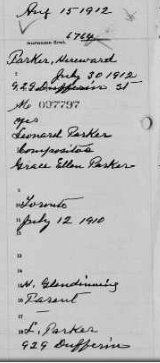
Leonard and Grace had at least two children
Hereward Parker and Earle E Parker who was born 24 December 1894 in Boston Mass.
Citing this Record:
"Ontario Births, 1869-1912," index, FamilySearch (https://familysearch.org/ark:/61903/1:1:FMH4-K2V : accessed 30 April 2015), Grace Ellen Parker in entry for Hereward Parker, 30 Jul 1912; citing Toronto, York, Ontario, Canada, registration number ; FHL microfilm 2,434,981.
Event Type: Birth
Event Date: 30 Jul 1912
Event Place: Toronto, York, Ontario, Canada
Registration Year: 1912
Gender: Male
Father's Name: Leonard Parker
Mother's Name: Grace Ellen Parker
Reference ID: 007797
GS Film Number: 2434981
Digital Folder Number: 004530275
Image Number: 01168
Indexing Project (Batch) Number: C05684-7

Leonard and Grace had at least two children
Hereward Parker and Earle E Parker who was born 24 December 1894 in Boston Mass.
Citing this Record:
"Ontario Births, 1869-1912," index, FamilySearch (https://familysearch.org/ark:/61903/1:1:FMH4-K2V : accessed 30 April 2015), Grace Ellen Parker in entry for Hereward Parker, 30 Jul 1912; citing Toronto, York, Ontario, Canada, registration number ; FHL microfilm 2,434,981.
Thursday, 7 May 2015
Leonard Parker
Name: Leonard Parker
Residence Place: Suffolk, England
Gender: Male
Christening Date: 28 Apr 1876
Christening Date (Original): 28 Apr 1876
Christening Place: Suffolk, England
Father's Name: Edward Parker
Mother's Name: Lucy Emma Kesson

Household Role Sex Age Birthplace
Edward Parker Head M 52 Norfolk, England
Lucy E Parker Wife F 49 London, England
Leonard Parker Son M 15 Suffolk, England
Frank Parker Son M 12 Suffolk, England
Harry Parker Son M 11 Suffolk, England
Horace Parker Son M 10 Suffolk, England
Eleanor Mitcham Boarder F 50 Cambridgeshire, England

He married Grace Ellen Parker

Edward Parker Head Married Male 52 1839 Commission Agent Norfolk, England
Transcription
Lucy E Parker Wife Married Female 49 1842 School Mistress Private London, Middlesex, England
Transcription
Leonard Parker Son Single Male 15 1876 Printers Apprentice Suffolk, England
Transcription
Frank Parker Son - Male 12 1879 Scholar Suffolk, England
Transcription
Harry Parker Son - Male 11 1880 Scholar Suffolk, England
Transcription
Horace Parker Son - Male 10 1881 Scholar Suffolk, England
Transcription
Eleanor Mitcham Boarder Single Female 50 1841 School Mistress Kinder Garten Cambridgeshire, England
Found in the Canadian Archives about the settlers.
Born in Birmingham, England - Barnardo took him into care in 1902, and he was sent to Canada on 20th Mar 1903, on the "Canada", destination Toronto. On arrival he was placed with a Mr Leonard Parker at Newbliss, Ontario. He stayed with that family until about 1908 (15 yrs) and is then supposed to have gone working on the Railroads.Thereafter I do not know what happened to him, the last report from Barnardo was dated 1909 saying he re visited Leonard Parker in the winter of 1908/9 and was working as a "Firer" on the railways. Family lore says he joined the CEF during WW1 and died in France, but this is not proven.
Gilmore, Thomas
Barnardo
1903
23 Sept 1893
Contact: Ian
Residence Place: Suffolk, England
Gender: Male
Christening Date: 28 Apr 1876
Christening Date (Original): 28 Apr 1876
Christening Place: Suffolk, England
Father's Name: Edward Parker
Mother's Name: Lucy Emma Kesson
Household Role Sex Age Birthplace
Edward Parker Head M 52 Norfolk, England
Lucy E Parker Wife F 49 London, England
Leonard Parker Son M 15 Suffolk, England
Frank Parker Son M 12 Suffolk, England
Harry Parker Son M 11 Suffolk, England
Horace Parker Son M 10 Suffolk, England
Eleanor Mitcham Boarder F 50 Cambridgeshire, England
Frank ,Harry and Leonard
He married Grace Ellen Parker
Edward Parker Head Married Male 52 1839 Commission Agent Norfolk, England
Transcription
Lucy E Parker Wife Married Female 49 1842 School Mistress Private London, Middlesex, England
Transcription
Leonard Parker Son Single Male 15 1876 Printers Apprentice Suffolk, England
Transcription
Frank Parker Son - Male 12 1879 Scholar Suffolk, England
Transcription
Harry Parker Son - Male 11 1880 Scholar Suffolk, England
Transcription
Horace Parker Son - Male 10 1881 Scholar Suffolk, England
Transcription
Eleanor Mitcham Boarder Single Female 50 1841 School Mistress Kinder Garten Cambridgeshire, England
Found in the Canadian Archives about the settlers.
Born in Birmingham, England - Barnardo took him into care in 1902, and he was sent to Canada on 20th Mar 1903, on the "Canada", destination Toronto. On arrival he was placed with a Mr Leonard Parker at Newbliss, Ontario. He stayed with that family until about 1908 (15 yrs) and is then supposed to have gone working on the Railroads.Thereafter I do not know what happened to him, the last report from Barnardo was dated 1909 saying he re visited Leonard Parker in the winter of 1908/9 and was working as a "Firer" on the railways. Family lore says he joined the CEF during WW1 and died in France, but this is not proven.
Gilmore, Thomas
Barnardo
1903
23 Sept 1893
Contact: Ian
Wednesday, 6 May 2015
Vlieland and Parker.
Several family members contact us with their new found items .
This time Len found out that Grace Ellen Parker married Leonard Parker in Canada .
That we did know .But we still have to search for more .
John Parker and Maria Vlieland are the parents of Grace Ellen.
This time Len found out that Grace Ellen Parker married Leonard Parker in Canada .
That we did know .But we still have to search for more .
Born PARKER Grace Ellen Norwich 4b 147 March 1880 daughter of John Parker and Maria Heath Vlieland. She marries Leonard Parker Name: Leonard Parker Event Type: Marriage Event Date: 12 Jul 1910 Event Place: Toronto, York, Ontario, Canada Age: 33 Birth Year (Estimated): 1877 Father's Name: Edward Parker Mother's Name: Lucy Kesson Spouse's Name: Grace Ellen Parker Spouse's Age: 30 Spouse's Birth Year (Estimated): 1880 Spouse's Father's Name: John Parker Spouse's Mother's Name: Maria Vlieland Registration Number: 003056 GS Film number: 1872068 Digital Folder Number: 4529579 Image Number: 00799 Collection: Leonard Parker, "Ontario Marriages, 1869-1927" Event Type: Death Event Date: 27 Jan 1937 Event Place: Forest Hill, , Ontario Gender: Age: 55 Birth Year (Estimated): 1882 Father's Name: John Parker Mother's Name: Maria Heath Spouse's Name: Leonard Parker Reference ID: 039810 GS Film number: 2435804 Digital Folder Number: 4530590 Image Number: 01602 Collection: Grace Ellen Parker, "Ontario Deaths,1869-1937 and Overseas Deaths, 1939-1947" Name: Leonard Parker Gender: Male Christening Date: 28 Apr 1876 Christening Place: Suffolk, England Father's Name: Edward Parker Mother's Name: Lucy Emma |
John Parker and Maria Vlieland are the parents of Grace Ellen.
His parents are Edward Parker and Lucy Emma Kesson .
They married December 1871 in Barrow .
Leonard Parker x Grace Ellen Parker .
Lucy Emma Kesson was Born December 1841 st Pancras
Leonard and Grace Ellen had at least two children
Hereward Parker and Earle E Parker who was born 24 December 1894 in Boston Mass.
Leonard Parker x Grace Ellen Parker .
Lucy Emma Kesson was Born December 1841 st Pancras
Leonard and Grace Ellen had at least two children
Hereward Parker and Earle E Parker who was born 24 December 1894 in Boston Mass.
But there is lots to find out
We will do some articles about them and the family.
We will do some articles about them and the family.
Tuesday, 5 May 2015
frogs and storks

Napoleon sends his brother Lodewijk Napoleon as a crowned stork to Holland as a ‘supreme chief of our Republic’.
Monday, 4 May 2015
de gevangenpoort.
This prison Arie was send to.
Was `de Gevangenpoort` in The Hague now a museum .

In this prison there was a special `hostage`chamber.
The prisoners in this room were well to do and had to pay for staying there.Almost a guilder each day.

They had their own beds and even their servant was allowed to serve them.
Not all prisoners were so lucky .
Some were branded.To mark them forever.
 The stork is symbol of the Hague.
On the fishmarket they had storks to clean the market .
Was `de Gevangenpoort` in The Hague now a museum .
In this prison there was a special `hostage`chamber.
The prisoners in this room were well to do and had to pay for staying there.Almost a guilder each day.
They had their own beds and even their servant was allowed to serve them.
Not all prisoners were so lucky .
Some were branded.To mark them forever.
On the fishmarket they had storks to clean the market .
Sunday, 3 May 2015
Crime against his homeland

Translation
Crime against his homeland
Something else , One Arie Vlieland .Master from Maassluis,whose intention it was certain persons .against the law , to transfer to England.
The same is for his willfull ,yes treacherously act ,arrested , where he awaits the consequences of his offending the law.
This prison is the gevangenpoort (prisongate) in The Hague .
It is a museum now .
Datum rekest 1808-05-05
Mandement Mandament Crimineel
Suppliant De Procureurs - generaal des Konings over het voormalig departement Holland
Tegenpartij Arie Vlieland, schipper, wonende te Rotterdam, voor 4 à 5 % van de vracht met Anthonie Frisch, eigenaar van een vissersvaartuig; John Le Vasseur en John Sleaven - overeenkomst over vervoeren van passagiers en goederen naar Engeland en met andere passagiers terug te brengen voor een som van 1.600 guldens; Cornelis van Prooyen, commissaris van de loodsen en seinposten in Briel
Betreft Overtreding van de poenale wetten tegen de handel en communicatie met Engeland geëmaneerd en dat moet gestraft worden
Beschikking van het hof Fiat mandament van dagvaarding in persoon
Bijzonderheden Pro Fisco
Bronverwijzing Nummer toegang: 3.03.01.01, inventarisnummer: 3255, folionummer: 014
Datum rekest 1808-05-05
Mandement Mandament Crimineel
Suppliant De Procureurs - generaal des Konings over het voormalig departement Holland
Tegenpartij John Sleaven, wonende te Amsterdam; overeenkomst met Anthonie Frisch, eigenaar van een vissersvaartuig en met Arie Vlieland, die als schipper diende - transporteren van personen en goederen naar Engeland voor een som van 1.600 guldens, welke som zal John Sleaven betalen, terwijl hij zelf van onderscheidene personen te samen ontvangen heeft een som van 2.000 guldens tegen een quitantie aan ieder gegeven heeft, gedeponeerd op zeker kantoor te Rotterdam. De reis verhinderd is geweest
Betreft John Sleaven heeft overtreden de poenale wetten tegen de handel en communicatie met Engeland geëmaneerd en dat moet gestraft worden
Beschikking van het hof Fiat mandament van dagvaarding in persoon
Bijzonderheden Pro Fisco
Bronverwijzing Nummer toegang: 3.03.01.01, inventarisnummer: 3255, folionummer: 013
Datum rekest 1808-05-05
Mandement Mandament Crimineel
Suppliant De Procureurs - generaal des Konings over het voormalig departement Holland
Tegenpartij Anthonie Frisch, wonende te Rotterdam, eigenaar van een vissersvaartuig; John Le Vasseur; John Sleaven; Cornelis van Prooyen, commissaris van de loodsen en seinposten in Briel - overeenkomst over vervoeren van passagiers en goederen naar Engeland en met andere passagiers terug te brengen voor een som van 1.600 guldens
Betreft Overtreding van de poenale wetten tegen de handel en communicatie met Engeland geëmaneerd en dat moet gestraft worden
Beschikking van het hof Fiat mandament van dagvaarding in persoon
Bijzonderheden Pro Fisco
Bronverwijzing Nummer toegang: 3.03.01.01, inventarisnummer: 3255, folionummer: 015
Persistent Link:
Death Arie Freland , age 53 years 10 month en 16 days
The same is for his willfull ,yes treacherously act ,arrested , where he awaits the consequences of his offending the law.
This prison is the gevangenpoort (prisongate) in The Hague .
It is a museum now .
Datum rekest 1808-05-05
Mandement Mandament Crimineel
Suppliant De Procureurs - generaal des Konings over het voormalig departement Holland
Tegenpartij Arie Vlieland, schipper, wonende te Rotterdam, voor 4 à 5 % van de vracht met Anthonie Frisch, eigenaar van een vissersvaartuig; John Le Vasseur en John Sleaven - overeenkomst over vervoeren van passagiers en goederen naar Engeland en met andere passagiers terug te brengen voor een som van 1.600 guldens; Cornelis van Prooyen, commissaris van de loodsen en seinposten in Briel
Betreft Overtreding van de poenale wetten tegen de handel en communicatie met Engeland geëmaneerd en dat moet gestraft worden
Beschikking van het hof Fiat mandament van dagvaarding in persoon
Bijzonderheden Pro Fisco
Bronverwijzing Nummer toegang: 3.03.01.01, inventarisnummer: 3255, folionummer: 014
Datum rekest 1808-05-05
Mandement Mandament Crimineel
Suppliant De Procureurs - generaal des Konings over het voormalig departement Holland
Tegenpartij John Sleaven, wonende te Amsterdam; overeenkomst met Anthonie Frisch, eigenaar van een vissersvaartuig en met Arie Vlieland, die als schipper diende - transporteren van personen en goederen naar Engeland voor een som van 1.600 guldens, welke som zal John Sleaven betalen, terwijl hij zelf van onderscheidene personen te samen ontvangen heeft een som van 2.000 guldens tegen een quitantie aan ieder gegeven heeft, gedeponeerd op zeker kantoor te Rotterdam. De reis verhinderd is geweest
Betreft John Sleaven heeft overtreden de poenale wetten tegen de handel en communicatie met Engeland geëmaneerd en dat moet gestraft worden
Beschikking van het hof Fiat mandament van dagvaarding in persoon
Bijzonderheden Pro Fisco
Bronverwijzing Nummer toegang: 3.03.01.01, inventarisnummer: 3255, folionummer: 013
Datum rekest 1808-05-05
Mandement Mandament Crimineel
Suppliant De Procureurs - generaal des Konings over het voormalig departement Holland
Tegenpartij Anthonie Frisch, wonende te Rotterdam, eigenaar van een vissersvaartuig; John Le Vasseur; John Sleaven; Cornelis van Prooyen, commissaris van de loodsen en seinposten in Briel - overeenkomst over vervoeren van passagiers en goederen naar Engeland en met andere passagiers terug te brengen voor een som van 1.600 guldens
Betreft Overtreding van de poenale wetten tegen de handel en communicatie met Engeland geëmaneerd en dat moet gestraft worden
Beschikking van het hof Fiat mandament van dagvaarding in persoon
Bijzonderheden Pro Fisco
Bronverwijzing Nummer toegang: 3.03.01.01, inventarisnummer: 3255, folionummer: 015
Persistent Link:
Death Arie Freland , age 53 years 10 month en 16 days
Subscribe to:
Posts (Atom)