Op heeden den 6e februari 1798 compareerde voor ons Sr. Gerhardus Adrianus
Entink secretaris mitsgaders voor de burgers Jan Hoekman en albert van
Noord, schepenen der beide Noordwijken, Langeveld en Offem; Hendrik Vlieland, thuis hoorende te Grefzeyl in Pruissen, doch op 't passeren dezes alhier present, ons secretaris en schepenen bekend in qualiteit als
schipper gevoerd hebbende het bomschip de jonge Elisabeth, dog welk schip te Rotterdam belaaden zijnde met zoute visch, kaas en andere soorten van
koopmanschappen op de reijze van daar naar Havre de Grace is genomen geworden door een Engelsch Koningsschip genaamd (zo als hij comparant is geinformeerd geworden)\Harpy, onder commando van Henry Bazely, esquire.
De welke verklaarde ten behoeven van alle de geenen wien zulks zouden mogen
aangaan en om te dienen daar en wanneer zulks zal nodig zijn, waar en waarachtig te weezen dat na dat zijn comparantes voornoemde schip en lading in de maand november des gepasseerdern-jaars 1797 op de bovengemelde wijze van-deeze stad na Havre de Grace door den bovegenoemde Henry Bazely commandant van het Engels Koningsschip Harpy was genomen, hij comparant op dat schip overgebragt was en daarna terwijl de zee zeer hoog stond, zijn schip de jonge Elisabeth uit het oog of gezigt verlooren had en hij al verder op den 22e der voornoemdemaand november van het voornoemde Koningsschip Harpy te Dover was aan land gezet,zoals zulks alles omstandig blijkt bij eene verklaaring door hem comparant op den zeIven 22e november voor Phineas Kennets notaris en in de stad en haven Dover in 't graafschap Kent en getuigen gepasseerd en op den 25e dito voor James Gravener een meester extraordinair in zijn Majesteijts Hooge Hoff van Cancelary beeedigd.
Hij comparant te Dover voornoemt of op eenige andere plaats niets hoegenaamdheeft gehoord of vernoomen van het door hem gevoerde schip, de jonge Elisabethof desselvs lading hier voren gemeld, maar dat hij comparant vervolgens hier te landen gearriveerd zijnde is geinformeerd geworden, dat te Noordwijk aan Zee op strand was aangedreeven of gespoeld en voorts geborgen een gijk van een grootzeijl van een bomschip, nevens een slaggaarde, dat hij comparant die twee stukken geexamineerd hebbende en dezelve heeft herkend en bevonden, dat dezelve gijk en slaggaarde behooren tot het voornoemde door hem gevoerde schip de jonge Elisabeth en dat hij comparant daar omme ter goeder trouw vastelijk geloofd en 't daar voor houd, dat het zelve schip de jonge Elisabeth met desselvs lading ten tijde dat hij zig aan boord van het meer gemelde schip Harpy bevond, het zelve uit het oog had verlooren, verongelukt en totaal verlooren gegaan is. Compareerde nog meede voor ons secretaris en schepenen de burgers Maarten
Kruijt, meester scheepstimmerman wonende te Noordwijk aan Zee en Jan de Booy, meestersmit wonende te Noordwijk Binnen, ons secretaris en schepenen bekend, dewelke meede verklaarden ter requisitie van alle de geenen welke aan desen eenigsints qeleegen zouden mogen zijn waar en waragtig te zijn dat ons bij examinatie gebleeken is, dat de te Noordwijk aan Zee gestrande gijk dezelve is welke ik tweede deposant in qualiteijt als scheepstimmerman hebbe gemaakt en ik derde deposant in qualiteijt als smit hebbe beslagen voor het bomschip genaamd de jonge Elisabeth in den jaare 1796 (doorgehaald: voor Bouwmans en zoon te Grefzeijl in Pruissen) nieuw uitgehaald. Erkennen aan de lengte en zwaarte van dezelve en aan 't beslag om dezelfde leggende. Bereid zijnde zij gezamentlijke deposanten het hier vooren staande gedeposeerde ieder in den haare met solemnele eede te bevestigen.
Ondertekend door:
H = merk van Hendrik Vlieland. (slaggaarde = peilstok)
Fuijt van Leeuwen Maarten Kruijt Jan de Booy Jan Hoekman Aalbert van Noord G.A. Entink, secretaris
all the original papers of this event
On February 6, 1798, he compared Sr. Gerhardus Adrianus
Entink secretary for the citizens Jan Hoekman and albert van
Noord, aldermen of both Noordwijk, Langeveld and Offem; Hendrik Vlieland, who is at home in Grefzeyl in Prussia, but on this pass, present here, our secretary and aldermen known in quality as
skipper having carried the young Elisabeth bomb ship, dog which ship loaded in Rotterdam with salty fish, cheese and other types of
merchants on the way from there to Havre de Grace have been taken by an English King ship called (so if he is informed comparant) \ Harpy, under the command of Henry Bazely, esquire.
The one declared for the benefit of all those who would be allowed to
and to serve where and when necessary, true and true, after that, the aforementioned ship and cargo in the month of November of the 1797 year passed in the above-mentioned manner from this town after Havre de Grace by the the aforementioned Henry Bazely commander of the English Royal Ship Harpy had been taken, he had been transferred to that ship in a consistent manner and then while the sea was very high, his ship had lost sight of young Elisabeth and he was already on the 22nd of the aforementioned November. of the aforementioned King's ship Harpy at Dover had been set ashore, as is evident from a statement made by him on November 22nd before Phineas Kennet's notary and in the town and port of Dover in County Kent and witnesses passed by and on the 25th ditto for James Gravener a master extraordinaire in his Majesteijts Hooge Hoff of Cancelary.
He compares in Dover or has not heard or heard of anything in any other place from the ship that he carried, the young Elisabeth or Desselvs cargo reported above, but that he then arrives to land here has been informed that in Noordwijk aan Zee had been drifted or washed on the beach and also salvaged a barge from a barge ship, in addition to a bombardment, that he comparant had examined those two pieces and recognized them and found that the barge and batting belong to the aforementioned ship the young Elisabeth and that he complies there for good faith and firmly believes that the self-employed ship was the young Elisabeth with Desselvs cargo at the time he was on board of the more frequently reported ship Harpy, the self from the had lost their eye, had an accident and lost Compared also for our secretary and aldermen Maarten
Kruijt, master ship carpenter living in Noordwijk aan Zee and Jan de Booy, mastersmit living in Noordwijk Binnen, known to us as secretary and aldermen, who also stated in order to requisition all those who might be somewhat disagree that we are true upon examination it was found that the beach stranded in Noordwijk aan Zee is the same which I made in second grade as a ship carpenter and I finished in third grade as smit for the bombship called the young Elisabeth in the year 1796 (canceled: for Bouwmans and son in Grefzeijl in Prussia). Recognize the length and weight of the same and the batter around the same laying. Being willing to be joint depositors, the aforementioned deputy will confirm each of them in their own oath.
Signed by:
H = brand of Hendrik Vlieland. (beating string = dipstick)
Fuijt van Leeuwen Maarten Kruijt Jan de Booy Jan Hoekman Aalbert van Noord G.A. Entink, secretary
all the original papers or this event
Friday, 20 March 2020


Thursday, 19 March 2020

Wednesday, 18 March 2020
Elizabeth Monfries
Name: Elizabeth Monfries
Event Type: Census
Event Date: 1891
County: Glamorganshire
Parish: St John Cardiff
Ecclesiastical Parish: ST ANDREWS
Registration District: Cardiff
Gender: Female
Age: 22
Marital Status: Single
Relationship to Head of Household: Daughter
Birth Year (Estimated): 1869
Birthplace: Glamorganshire, Wales
Charlotte Monfries
Head
F
67
Broad Clist, Devonshire, England
Margaret Monfries
Daughter
F
25
Germany
Elizabeth Monfries
Daughter
F
22
Glamorganshire, Wales
Event Type: Census
Event Date: 1891
County: Glamorganshire
Parish: St John Cardiff
Ecclesiastical Parish: ST ANDREWS
Registration District: Cardiff
Gender: Female
Age: 22
Marital Status: Single
Relationship to Head of Household: Daughter
Birth Year (Estimated): 1869
Birthplace: Glamorganshire, Wales
Charlotte Monfries
Head
F
67
Broad Clist, Devonshire, England
Margaret Monfries
Daughter
F
25
Germany
Elizabeth Monfries
Daughter
F
22
Glamorganshire, Wales
D Davies
Boarder
M
32
Llanfair-Ar-Y-Bryn, Carnarvonshire, England
Annie P Collow
Servant
F
22
Oxfordshire, England
Charlotte H Hall
Granddaughter
F
3
India British Subject

Name: Elizabeth Monfries
Event Type: Census
Event Date: 1911
Event Place: Llandaff, Glamorgan, Wales, United Kingdom
County: Glamorganshire
Parish: Llandaff
Sub-District: Llandaff
Sub-District Number: 1
District Number: 588
Enumeration District: 4
Registration District: Cardiff
Gender: Female
Age: 42
Marital Status: Single
Marital Status: SINGLE
Occupation: GOVERNESS
Number in Family: 4
Birth Year (Estimated): 1869
Birthplace: Cardiff, Glamorganshire
Relationship to Head of Household: Sister-in-law
Boarder
M
32
Llanfair-Ar-Y-Bryn, Carnarvonshire, England
Annie P Collow
Servant
F
22
Oxfordshire, England
Charlotte H Hall
Granddaughter
F
3
India British Subject

Name: Elizabeth Monfries
Event Type: Census
Event Date: 1911
Event Place: Llandaff, Glamorgan, Wales, United Kingdom
County: Glamorganshire
Parish: Llandaff
Sub-District: Llandaff
Sub-District Number: 1
District Number: 588
Enumeration District: 4
Registration District: Cardiff
Gender: Female
Age: 42
Marital Status: Single
Marital Status: SINGLE
Occupation: GOVERNESS
Number in Family: 4
Birth Year (Estimated): 1869
Birthplace: Cardiff, Glamorganshire
Relationship to Head of Household: Sister-in-law
Tuesday, 17 March 2020
Emma Rouse

Emma Rouse (1843-1928), was the second child of Edwin Rouse (1806-1862) and his wife Hannah Hipkins (1819-1907) and was a granddaughter of Richard and Elizabeth Rouse of Rouse Hill in the Parramatta district of New South Wales.
She was born at the Rouse family property Guntawang near Mudgee but by the time this photograph was taken, probably in late 1855, Edwin and Hannah Rouse and their children had come to live at Rouse Hill, Edwin having taken responsibility for the property following his father's death. In 1871 Emma married Lieutenant Dudley Davison Batty, an English army officer, in London. They had met on board the sailing ship Sobraon in 1869, when Emma and her mother, brother Edwin and sister Lizzie were returning from a European trip and Dudley Batty was making a sea voyage for the sake of his health.


family groups
Rouse, Edwin Stephen, 1849-1931.
Rouse, Elizabeth (Lizzie), 1845-1931.
Rouse, Mary Phoebe, 1847-1931.
Rouse, Emma, 1843-1928.
Rouse, Richard, 1842-1903.

Dudley Batty died in 1878 and Emma never returned to Australia. [ref. Caroline Rouse Thornton Rouse Hill house and the Rouses 1988].
Emma Rouse is the mother of Dudley Batty.
We know that Dudley Batty her son was married with Phoebe Mary Vlieland and he toon photographs of Rouse Hill while visiting.
* South Kensington seems to have been the Batty family home – Comeragh Road, where Phoebe and Dudley lived at Aubrey's birth is just round the corner from Redcliffe Gardens, where Dudley's elder sister was stillborn (20 November 1872, Sydney Herald 27 January 1873) and where he and his wife Emma lived on their marriage (20 July 1871) – officiated by Dudley's two brothers, Edmund and George Staunton, both Reverends (Sydney Herald, 2 October 1871)!
Source: Rouse Hill House & Farm ; R86/513-4
MARRIAGES. On July 20, at St. John's Church, Fulham, by the Right Rev. the Lord Bishop of Sydney, assisted by the Rev. Edmund Batty,
vicar, and the Rev. George Staunton Batty, brothers of the
bridegroom, DUDLEY BATTY, Esq., Lieutenant unattached late
66th and 67th Regiments, to EMMA, eldest daughter of the lateFix this text
EDWIN ROUSE, Esq., of Rouse Hall, Australia.


This carte-de-visite is one item within a small album containing photographs of members of the extended Rouse and Terry families.Emma Rouse (1843-1928), was the second child of Edwin Rouse (1806-1862) and his wife Hannah Terry Hipkins (1819-1907) and was a granddaughter of Richard and Elizabeth Rouse of Rouse Hill in the Parramatta district of New South Wales. She was born at the Rouse family property Guntawang near Mudgee but at the time this photograph was taken she was living with her siblings and widowed mother at Rouse Hill. This carte-de-visite portrait seems to be one of a suite of four studio portraits of Edwin and Hannah's children taken at a single session. In 1871 Emma married Lieutenant Dudley Batty, an English army officer, in London. They had met on board the sailing ship Sobraon in 1869, when Emma and her mother, brother Edwin and sister Lizzie were returning from a European trip and Dudley Batty was making a sea voyage for the sake of his health. Dudley Batty died in 1878 and Emma never returned to Australia. [ref. Caroline Rouse Thornton Rouse Hill house and the Rouses 1988].
Source:
Rouse Hill House & Farm ; HR88/18-17. The Hamilton Rouse Hill Trust Collection.
Rights:
You may save or print this image for research and study. If you wish to use it for any other purposes, you must contact the Historic Houses Trust to request permission.
Material Type:
Picture
Record number:
46284
Source:
Rouse Hill House & Farm ; HR88/18-17. The Hamilton Rouse Hill Trust Collection.
Rights:
You may save or print this image for research and study. If you wish to use it for any other purposes, you must contact the Historic Houses Trust to request permission.
Material Type:
Picture
Record number:
46284
Monday, 16 March 2020
Adriana Wilhelmina van Genderen
Adriana Wilhelmina van Genderen, geboren op 10 januari 1815 te Well
daughter of Wouter van Genderen, landbouwer van beroep
MoederPetronella Wolffers, zonder beroep
Father Johannes van der Voet
Mother Adriana Wilhelmina van Genderen
Deceased Jan Frederik van der Voet, born in Warmond, 43 years old
Partner Christophora Henrica Ernestina Gerharda Lichtenbelt
Marriage on August 21, 1884 in Vleuten, province Utrecht (Netherlands)
Father of groom Johannes van der Voet
Mother of groom Adriana Wilhelmina van Genderen
Groom Jan Frederik van der Voet, born in Warmond, 33 years old
Bride Christophora Henrica E G Lichtenbelt, born in Broek in Waterland, 35 years old
Father of bride Jan Hendrik Lichtenbelt
Mother of bride Johanna Hendrika Wilterdink
Marriage on September 30, 1880 in Vleuten, province Utrecht (Netherlands)
Father of groom Jan Hendrik Lichtenbelt
Mother of groom Johanna Hendrica Wilterdink
Groom Jan Hendrik Lichtenbelt, born in Aalsmeer, 28 years old
Bride Catharina van der Voet, born in Warmond, 24 years old
Father of bride Johannes van der Voet
Mother of bride Adriana Wilhelmina van Genderen
Death on February 22, 1936 in Utrecht, province Utrecht (Netherlands)
FatherJohannes van der Voet
MotherAdriana Wilhelmina van Genderen
Deceased (female) Catharina van der Voet, 64 years old
PartnerJan Hendrik Lichtenbelt
Marriage (huwelijksakte) on September 30, 1875 in Warmond,
Father of groom Gerardus Adrianus Melchier
Mother of groom Maria Wilhelmina de Jong
Groom Hendrik Willem Melchier, born in Spaarndam, 28 years old
Bride Cornelia van der Voet, born in Warmond, 25 years old
Father of bride Johannes van der Voet
Mother of bride Adriana Wilhelmina van Genderen
Marriage (huwelijksakte) on November 25, 1875 in Warmond, province Zuid-Holland (Netherlands)
Father of groom Maarten Spaargaren
Mother of groom Jawiktje Vooren
Groom Johannes Cornelis Spaargaren, born in Oegstgeest, 22 years old
Bride Wilhelmina van der Voet, born in Warmond, 22 years old
Father of bride Johannes van der Voet
Mother of bride Adriana Wilhelmina van Genderen
Marriage (huwelijksakte) on May 24, 1877 in Warmond, province Zuid-Holland (Netherlands)
Father of groom Matthijs Willem Spoor
Mother of groom Anitte Klara Krijna van der Gaag
Groom Karel Abram Spoor, born in Voorburg, 23 years old
Bride Aaltje van der Voet, born in Warmond, 24 years old
Father of bride Johannes van der Voet
Mother of bride Adriana Wilhelmina van Genderen
Marriage on September 30, 1902 in Zandvoort (Netherlands)
Father of groom Jacobus Everhardus Vlaanderen
Mother of groom Jacoba Johanna Couvee
Groom Jacobus Everhardus Vlaanderen, born in Leiden, 67 years old, hotelhouder by profession
Bride Margaretha van der Voet, born in Warmond, 47 years old
Father of bride Johannes van der Voet
Mother of bride Adriana Wilhelmina van Genderen
Remark Weduwnaar van Cateau Stikkelorum. Weduwe van Cornelis Pieter Vlieland.
Death on July 21, 1928 in Haarlem (Netherlands)
Father Johannes van der Voet
Mother Adriana Wilhelmina van Genderen
Deceased Margaretha van der Voet, born in Warmond, 73 years old
Widower Jacobus Everhardus Vlaanderen
Remark Eerder weduwe van Cornelis Pieter Vlieland
=
daughter of Wouter van Genderen, landbouwer van beroep
MoederPetronella Wolffers, zonder beroep
Father Johannes van der Voet
Mother Adriana Wilhelmina van Genderen
Deceased Jan Frederik van der Voet, born in Warmond, 43 years old
Partner Christophora Henrica Ernestina Gerharda Lichtenbelt
Marriage on August 21, 1884 in Vleuten, province Utrecht (Netherlands)
Father of groom Johannes van der Voet
Mother of groom Adriana Wilhelmina van Genderen
Groom Jan Frederik van der Voet, born in Warmond, 33 years old
Bride Christophora Henrica E G Lichtenbelt, born in Broek in Waterland, 35 years old
Father of bride Jan Hendrik Lichtenbelt
Mother of bride Johanna Hendrika Wilterdink
Marriage on September 30, 1880 in Vleuten, province Utrecht (Netherlands)
Father of groom Jan Hendrik Lichtenbelt
Mother of groom Johanna Hendrica Wilterdink
Groom Jan Hendrik Lichtenbelt, born in Aalsmeer, 28 years old
Bride Catharina van der Voet, born in Warmond, 24 years old
Father of bride Johannes van der Voet
Mother of bride Adriana Wilhelmina van Genderen
Death on February 22, 1936 in Utrecht, province Utrecht (Netherlands)
FatherJohannes van der Voet
MotherAdriana Wilhelmina van Genderen
Deceased (female) Catharina van der Voet, 64 years old
PartnerJan Hendrik Lichtenbelt
Marriage (huwelijksakte) on September 30, 1875 in Warmond,
Father of groom Gerardus Adrianus Melchier
Mother of groom Maria Wilhelmina de Jong
Groom Hendrik Willem Melchier, born in Spaarndam, 28 years old
Bride Cornelia van der Voet, born in Warmond, 25 years old
Father of bride Johannes van der Voet
Mother of bride Adriana Wilhelmina van Genderen
Marriage (huwelijksakte) on November 25, 1875 in Warmond, province Zuid-Holland (Netherlands)
Father of groom Maarten Spaargaren
Mother of groom Jawiktje Vooren
Groom Johannes Cornelis Spaargaren, born in Oegstgeest, 22 years old
Bride Wilhelmina van der Voet, born in Warmond, 22 years old
Father of bride Johannes van der Voet
Mother of bride Adriana Wilhelmina van Genderen
Marriage (huwelijksakte) on May 24, 1877 in Warmond, province Zuid-Holland (Netherlands)
Father of groom Matthijs Willem Spoor
Mother of groom Anitte Klara Krijna van der Gaag
Groom Karel Abram Spoor, born in Voorburg, 23 years old
Bride Aaltje van der Voet, born in Warmond, 24 years old
Father of bride Johannes van der Voet
Mother of bride Adriana Wilhelmina van Genderen
Marriage on September 30, 1902 in Zandvoort (Netherlands)
Father of groom Jacobus Everhardus Vlaanderen
Mother of groom Jacoba Johanna Couvee
Groom Jacobus Everhardus Vlaanderen, born in Leiden, 67 years old, hotelhouder by profession
Bride Margaretha van der Voet, born in Warmond, 47 years old
Father of bride Johannes van der Voet
Mother of bride Adriana Wilhelmina van Genderen
Remark Weduwnaar van Cateau Stikkelorum. Weduwe van Cornelis Pieter Vlieland.
Death on July 21, 1928 in Haarlem (Netherlands)
Father Johannes van der Voet
Mother Adriana Wilhelmina van Genderen
Deceased Margaretha van der Voet, born in Warmond, 73 years old
Widower Jacobus Everhardus Vlaanderen
Remark Eerder weduwe van Cornelis Pieter Vlieland
=
Friday, 13 March 2020
Richard Rouse

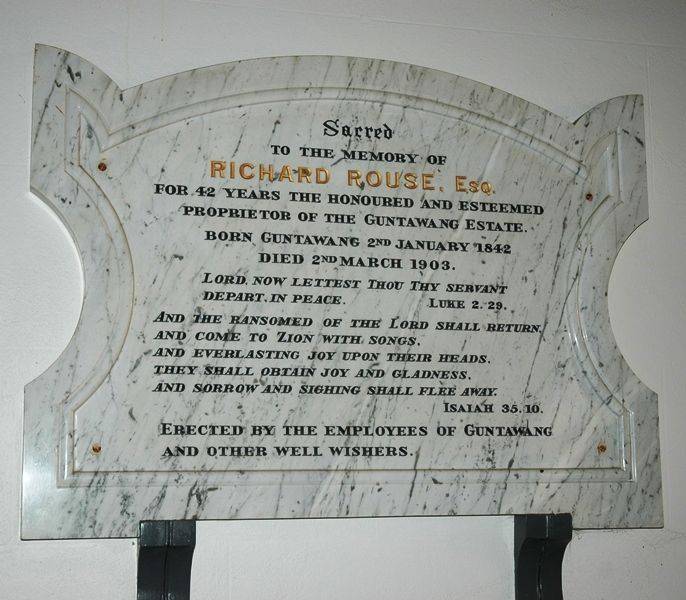
The plaque erected by the employees of Guntawang commemorates Richard Rouse (1842-1903)
Richard Rouse (1842-1903) and Richard junior (1843-1906), pastoralists and stud-breeders, were first cousins and grandsons of Richard Rouse of Rouse Hill. Richard was born on 2 January 1842 at Guntawang, near Mudgee, New South Wales, eldest son of Edwin Rouse, grazier. In 1861 he managed Guntawang, 4000 acres (1619 ha) on the Cudgegong River near Mudgee and inherited it on the death of his father the next year.
He bred pedigree carriage horses, cattle and merino sheep and Guntawang became noted for its lavish hospitality. He also held other properties. He was also the principal shareholder in the Guntawang Freehold Gold Mining Co. He represented Mudgee in Parliament 1876-77 and 1879. In 1895 he published The Australian Horse Trade, which stressed the breeding advantages of the ’Yorkshire coach-horse’ for the United Service Institution. Rouse was a magistrate and regularly sat on the bench. He was also mayor of Gulgong in 1876 and 1899-1903 and a member of the Union Club and first president of the Gulgong Turf Club in 1871.
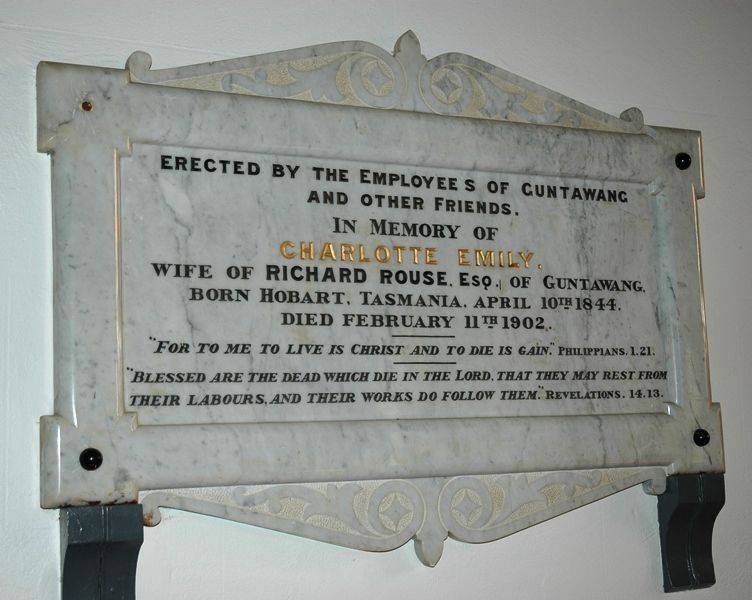
Tablet erected by the employees of Guntawang to Charlotte Rouse, the wife of Richard Rouse.
Richard Rouse bred pedigree carriage horses, cattle and merino sheep and Guntawang became noted for its lavish hospitality. He also held other properties. He was also the principal shareholder in the Guntawang Freehold Gold Mining Co.
He represented Mudgee in Parliament 1876-77 and 1879. In 1895 he published The Australian Horse Trade, which stressed the breeding advantages of the ’Yorkshire coach-horse’ for the United Service Institution. Rouse was a magistrate and regularly sat on the bench. He was also mayor of Gulgong in 1876 and 1899-1903 and a member of the Union Club and first president of the Gulgong Turf Club in 1871. Richard married Charlotte Emily, the daughter of James Barnard, in 1865 in Hobart Town.

Wednesday, 11 March 2020
Lizzie Rouse 1845-1931

Elizabeth (Lizzie) Rouse (1845-1931) was the third child of Edwin Rouse and his wife Hannah Hipkins and was a granddaughter of Richard and Elizabeth Rouse of Rouse Hill. She was born at the Rouse family property Guntawang near Mudgee but by the time this photograph was taken, probably in late 1855, Edwin and Hannah Rouse and their children had come to live at Rouse Hill, Edwin having taken responsibility for the property following his father's death. This daguerreotype portrait is one of a suite of studio portraits of Edwin and Hannah’s three daughters taken at a single session. The girls were described by a family friend as ‘Blooming Emma’, ‘Laughing Lizzie’, and ‘Phoebe like a fawn’1 – although Lizzie is sombre, not laughing, in this photograph. As a young woman Lizzie travelled back and forth between Australia and England with her mother and siblings. In 1884 she married Scottish-born Major Frederic Buckley Campbell of the Connaught Rangers in London and remained in England for the rest of her life.
watercolour
Tuesday, 10 March 2020
Edwin Stephen Rouse


Early Photographs of Edwin Stephen Rouse and his wife Bessie


The family Rouse outside their home in 1859
Edwin and Bessie's two daughters, Nina and Kathleen were born in 1875 and 1878, into the leisurely confident world of the late 19th century squattocracy, but the financial troubles of the 1890s - the economic depression that affected city and country alike - cast shadows over this sunlit landscape of picnic races, house parties and seasons in town. Those shadows grew with the 20th century and Edwin Stephen's lack of business sense.
In 1895 Nina Rouse made a socially suitable match with George Terry of nearby Box Hill, where they lived extravagantly for a few years and brought up their five sons, but returned to Rouse Hill, bankrupt and resented by Kathleen, soon after Bessie's death in 1924.
Kathleen, in love with a Latvian emigreé refused residency in Australia and working in Manchuria, travelled to see him in 1930 and again two years later. She never returned from Manchuria; in August 1932 she was murdered in Harbin. The exclusion of her sister and her nephews as beneficiaries of her will caused further conflict within the family and the furnishings of the house narrowly escaped dispersal.
Nina and George Terry remained at Rouse Hill, George dying in 1957. Nina lived on with her reminiscences and the remnants of an affluent past until her death in 1968. As her grand-daughter, Caroline Thornton has written 'Granny seemed to hold the key to another world'.
Attrition of the farm through subdivision left only 100 acres, but in and around the house little was changed, little was added. Nina's son, Gerald, and his family lived in the cottage beyond the farmyard; another son Roderick lived nearby. After further subdivision between her sons, all that remained of the estate was 20 acres (13 hectares) in the ownership of Gerald and Roderick Terry. In 1977 Roderick sold his share of Rouse Hill to his daughter Miriam, and her husband Ian Hamilton.

Rouse, Edwin Stephen (1849–1931)
Mr. Edwin Stephen Rouse, who died at his residence, Rouse Hill House, Rouse Hill, on Tuesday, was a member of a very old Australian family. He was 82 years of age.
Born at Guntawang, he was the younger son of the late Mr. Edwin Rouse of Guntawang and Rouse Hill and a grandson of Mr. Richard Rouse, the pioneer. He was educated at Macquarie Fields and resided at his home at Rouse Hill since 1854. In 1874 he married Miss Elizabeth Ann Buchanan at St. John's Church, Darlinghurst. He and his brother Richard Rouse of Guntawang, were the breeders of a noted breed of carriage horses and also were successful on the turf, winning the Sydney Cup for two successive years with their mare, Viva, the trainer being the veteran Mr Harry Rayner of Randwick. Mr. Rouse was for 60 years a member of the Union Club. Mrs Rouse predeceased him. Two daughters survive him.
The funeral took place at St. Matthew's Church of England cemetery, Windsor, after a service held in the Rouse Hill Church.
The chief mourners were—Mrs. G. A. Terry and Miss Kathleen Rouse (daughters), Mr. G. A. Terry (son in law), Messrs G. R. E. G. and N. Terry (grandsons), Miss Marian Rouse (niece), Mrs. Stanley Rouse (niece), Mr. John G. Rouse (nephew), Mrs. R. B. Terry (granddaughter), Among others present at the graveside were:—Mr. W. Young (representing Mr. R. R. Dangar (nephew), Mr. and Mrs. J. E. Gosling, Miss Pringle, Miss Pendergast, Mrs. Haigh, Miss Mildred Callaghan, Mr. and Mrs. Crowley, Mr. Norman Cox, General Paine, Messrs. J. B. Johnstone, Horsley, Cecil Iceley, Arthur Thompson, Wright, Pearse (senior), E. and C. Pearse, Jamieson, and Nash and the staff of Rouse Hill House.
Monday, 9 March 2020
Edwin Rouse (1806-1862)

Photograph on ivory of Edwin Rouse (1806-1862), hand coloured simulating a miniature painting and mounted in purple velvet case. Possibly intended as a mourning object belonging to either his wife Hannah Hipkins (1819-1907) or his youngest son, Edwin Stephen (1849-1931). The design of the case, with integral stand, suggests it was an intimate keepsake intended for travelling.
DEATH.
ROUSE-On the 10th April, at Percy Lodge, Potts' Point, Edwin
Rouse, Esq., of Rouse-hill, near Windsor, aged 56 years.
 Edwin (1806-1862), inherited Rouse Hill. With his English-born wife, Hannah (nee Hipkins), Edwin brought the plain, solid Georgian house up to date. After years of living at Guntawang, the principal family property west of the mountains, Edwin and Hannah renovated Rouse Hill, probably engaging the architect-builder James Houison. They added the canopied verandah and the two storeyed service wing, installed marble chimney pieces on the ground floor and bought furniture in the fashionable Louis revival style.
It was Edwin Rouse's other land holdings, beyond the mountains, rather than the Rouse Hill House & Farm, that supported the Rouse family. This wealth was enjoyed into the next generation by Edwin's son, Edwin Stephen Rouse who, aged twelve, inherited Rouse Hill on his father's early death in 1862.
Edwin Stephen (1849-1931) married well, in 1874, and Bessie Buchanan (1843-1924) became the mistress of Rouse Hill. (His mother, Hannah, lived much of the remainder of her life in England with two of her daughters). Again the house was redecorated, in Bessie's fashionable taste for Art Decoration, while Edwin Stephen improved the estate, notably by the building of impressive stables in 1876 designed by the architect John Horbury Hunt.
watercolour
 family groups
Rouse, Edwin Stephen, 1849-1931.
Rouse, Elizabeth (Lizzie), 1845-1931.
Rouse, Mary Phoebe, 1847-1931.
Rouse, Emma, 1843-1928.
Rouse, Richard, 1842-1903.
ROUSE-On the 10th April, at Percy Lodge, Potts' Point, Edwin
Rouse, Esq., of Rouse-hill, near Windsor, aged 56 years.

It was Edwin Rouse's other land holdings, beyond the mountains, rather than the Rouse Hill House & Farm, that supported the Rouse family. This wealth was enjoyed into the next generation by Edwin's son, Edwin Stephen Rouse who, aged twelve, inherited Rouse Hill on his father's early death in 1862.
Edwin Stephen (1849-1931) married well, in 1874, and Bessie Buchanan (1843-1924) became the mistress of Rouse Hill. (His mother, Hannah, lived much of the remainder of her life in England with two of her daughters). Again the house was redecorated, in Bessie's fashionable taste for Art Decoration, while Edwin Stephen improved the estate, notably by the building of impressive stables in 1876 designed by the architect John Horbury Hunt.
watercolour
Rouse, Edwin Stephen, 1849-1931.
Rouse, Elizabeth (Lizzie), 1845-1931.
Rouse, Mary Phoebe, 1847-1931.
Rouse, Emma, 1843-1928.
Rouse, Richard, 1842-1903.
Sunday, 8 March 2020
Hannah Terry Rouse née Hipkins

Hannah Terry Rouse 1819-1907
Hannah Terry Rouse, nee Hipkins (1819-1907) was born in Tipton, Staffordshire, England, daughter of Stephen and Nancy Hipkins, She came to New South Wales in 1837 with her aunt and namesake Hannah Terry, widow of John Swan Terry and sister-in-law of well-known Sydney wealthy emancipist Samuel Terry. Hannah Hipkins met her future husband Edwin Rouse, third son of Richard and Elizabeth Rouse of Rouse Hill, at the Terry family property Box Hill, near Windsor, the home of Edwin’s sister Eleanor Terry. They married in 1840 and lived for the first fifteen years of their marriage on the Rouse family property . By the time this photograph was taken, probably in late 1855, Edwin and Hannah Rouse and their children had come to live at Rouse Hill, Edwin having taken responsibility for the estate following his father's death. In her long life Hannah travelled to Australia and back to England four times, spending more and more time in England. She died at Brighton, Sussex, in 1907.
She was the mother of Emma Rouse .
Emma Rouse (1843-1928), was the second child of Edwin Rouse (1806-1862) and his wife Hannah Hipkins (1819-1907) and was a granddaughter of Richard and Elizabeth Rouse of Rouse Hill in the Parramatta district of New South Wales.
She was born at the Rouse family property Guntawang near Mudgee but by the time this photograph was taken, probably in late 1855, Edwin and Hannah Rouse and their children had come to live at Rouse Hill, Edwin having taken responsibility for the property following his father's death. In 1871 Emma married Lieutenant Dudley Davison Batty, an English army officer, in London. They had met on board the sailing ship Sobraon in 1869, when Emma and her mother, brother Edwin and sister Lizzie were returning from a European trip and Dudley Batty was making a sea voyage for the sake of his health.
She was born at the Rouse family property Guntawang near Mudgee but by the time this photograph was taken, probably in late 1855, Edwin and Hannah Rouse and their children had come to live at Rouse Hill, Edwin having taken responsibility for the property following his father's death. In 1871 Emma married Lieutenant Dudley Davison Batty, an English army officer, in London. They had met on board the sailing ship Sobraon in 1869, when Emma and her mother, brother Edwin and sister Lizzie were returning from a European trip and Dudley Batty was making a sea voyage for the sake of his health.

Hannah Rouse’s cameo ring
This cameo ring is probably a travel souvenir. It belonged to Hannah Terry Rouse (1819-1907), the widow of Edwin Rouse (1806-1862) of Rouse Hill House and it is likely that she bought it during her ‘Grand Tour’ of Europe in 1868-1869, when she was accompanied by two of her daughters and her younger son, Edwin Stephen Rouse. Hannah owned a copy of John Murray’s Handbook to Rome and its Environs which she bought while staying at the Hotel d’Angleterre in Rome in February 1869. This guidebook provided advice on where to buy antiquities, mosaics and cameos. Cameo jewellery was a fashionable memento of a trip to Italy and immensely popular during the reign of Queen Victoria. They often depicted subjects drawn from ancient Rome, such subjects being thought to connote the wearer’s connoisseurship, taste, and classical learning. Hannah’s ring features a profile of the Roman Emperor Augustus. It is made of moulded white glass adhered to a dark glass ground and is set in a twisted gold rope frame. Hannah is wearing it in a photograph taken in the studio of London photographers Elliott & Fry, perhaps taken shortly before her return to Australia.


Hannah Rouse’s onyx brooch
There are several mysteries about this elegant enamelled gold brooch, beginning with its date and original owner. It is believed to have belonged to Hannah Terry Rouse, nee Hipkins (1819-1907) of Rouse Hill House, and to have been acquired following the death of her husband Edwin Rouse in 1862. The brooch, 2.5cm in diameter, certainly has the appearance of a mourning brooch, with a central onyx encircled with a band of black enamel set with seed pearls, denoting tears. The pearls are also ‘colourless’ and therefore appropriate for mourning but the onyx is polished to reveal a narrow band of white in the black and the combination of white and black was fashionable in Victorian times, representing a form of elegant reticence for married women of a certain age. Mourning brooches of this kind would usually have a glass back containing a lock of the loved one’s hair. There is no such compartment on this brooch but there is evidence that the back has been remade and the safety pin is definitely a later addition. Perhaps the original back was replaced because the glass had broken?

DEATH OF MRS ROUSE
 News has come to Sydney of the
death, at Brighton, England, on the
4th instant, of Mrs Hannah T. Rouse,
a very old colonist, at the age of 87
years. She was the widow of the late
Mr Edwin Rouse, of Rouse Hill and
Guntawang. Her eldest son, Mr Ric-
hard Rouse, of Guntawang, died three
years ago. Three daughters and one
son survive her—namely, Mrs Dudley
Batty (Brighton), Mrs Frederick
Campbell (Kent), Mrs A. A. Dangar
(Baroona, Singloton), and Mr Edwin
S. Rouse (Rouse Hill).
watercolour
family groups her children
Rouse, Edwin Stephen, 1849-1931.
Rouse, Elizabeth (Lizzie), 1845-1931.
Rouse, Mary Phoebe, 1847-1931.
Rouse, Emma, 1843-1928.
Rouse, Richard, 1842-1903.
Thursday, 5 March 2020
William Batty and his Hippodrome
BATTY'S HIPPODROME

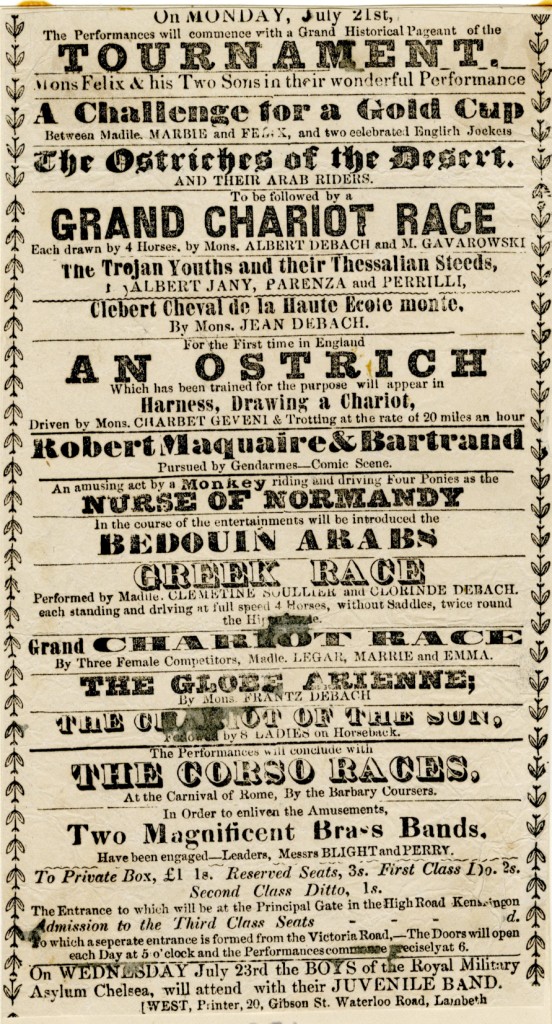
WITHIN five minutes' walk of the Crystal Palace, Mr. Batty has erected a novel kind of circus, calculated to be a rival to his own Astley's, but for the difference of locality and aim. Opposite the Broad-walk, Kensington Gardens, an amphitheatre of enormous dimensions, under the title of "the Hippodrome," attracts all lovers of horsemanship. It consists of a circle of boxes and stalls divided by two opposite orchestra stations, which are occupied by two brass bands, who continue playing during the performance and an hour previous. The seats for the audience are covered, but the arena for Equestrian exhibition is open to the air and sky. We are thus carried back to the ancient times of Greece and Rome, and our own Elizabethan era; and the entertainments are suitable to these classical associations. Tournaments, chariot races, Trojan youths and Thessalian steeds, and such reproductions from the days of old, are the prevailing amusements. We believe, indeed, that the bills attempt no delusion in stating, that these exercises are "on a scale of extent and grandeur hitherto unattempted in England." The artists have been drafted from the Hippodrome at Paris, the principal being M. Louis Soullier, equerry to his Highness the Sultan Medjid of Turkey and the Emperor of Russia, and "his numerous and highly-trained stud of horses" to whom may be added his company. The performance on Wednesday commenced with a pageant representing the meeting of Henry VIII. and Francis I. on the Field of the Cloth of Gold . . . The second part was not less interesting. The Brazilian coursers, performed by the three brothers Debach, on four horses each, was a highly exciting scene - presenting a trial of skill emulously carried out. But this was exceeded in interest by that exhibited by three female competitors, in a grand chariot race. The performances concluded with a monkey riding and driving four ponies; dames of the chase, in characteristic costume, on leaping palfreys; M. Frantz Debach, on the glove arienne, a well-known but difficult feat, and in this instance executed with inimitable grace; and the Corso races by Barbary coursers, as exhibition at the Carnival of Rome. We have omitted to mention an exceedingly amusing race by two ostriches of the desert, with their Arab riders, one of whom was thrown in the experiment.
Illustrated London News, Jan.-June, 1851

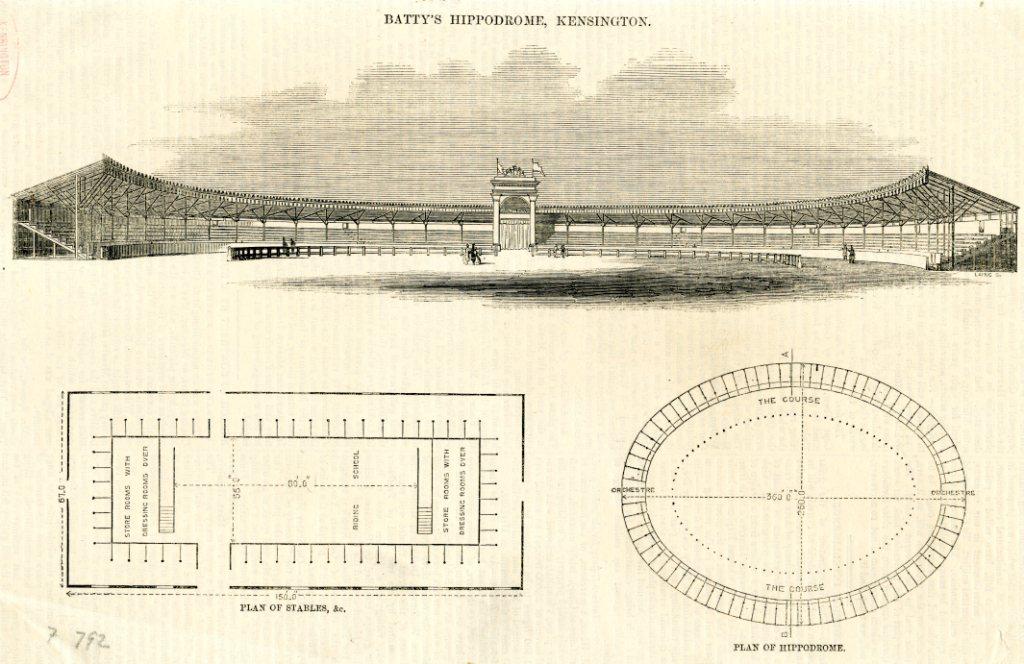
In the autumn of 1850, William Batty, a famous circus proprietor, acquired some land within five minutes walk of the new world-wonder, the 'Crystal Palace,' and erected thereon an elliptical-roofed pavilion which accommodated many thousands of spectators, and had a large arena open to the sky.
The Royal Hippodrome was opened in May 1851 with a French troupe brought over from the Hippodrome at Paris. The performances generally took place in the evening, and the lowest price of admission was sixpence. Two brass bands of a rather blatant character enlivened the proceedings. Favourite features of the entertainment were a Roman chariot race and a 'triumphal race of the Roman consuls', who were represented by the three brothers Debach, each guiding six horses. . . . Other attractions were balloon ascents, and F.Debach's journey on the Arienne Ball up and down a narrow inclined plank.
The Hippodrome closed with the [Great] Exhibition and only lived for one other season in 1852. Subsequently in the sixties it was used as a riding school. The site lay nearly opposite the broad walk of Kensington Gardens, between part of Victoria Road and Victoria Walk and the present Palace Gate. De Vere Gardens mainly occupy the site.
Warwick Wroth, Cremorne and the later London Gardens, 1907
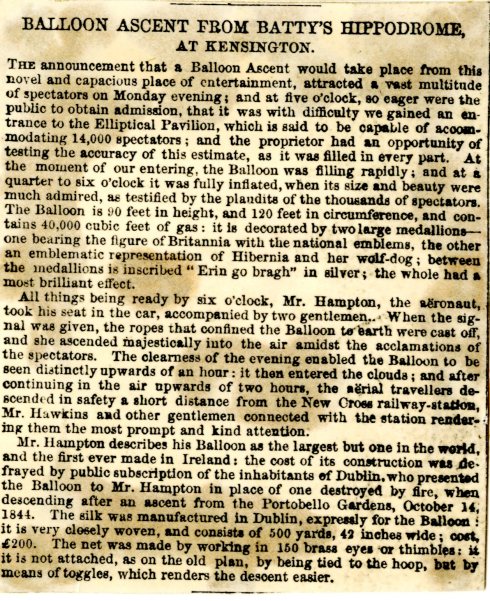
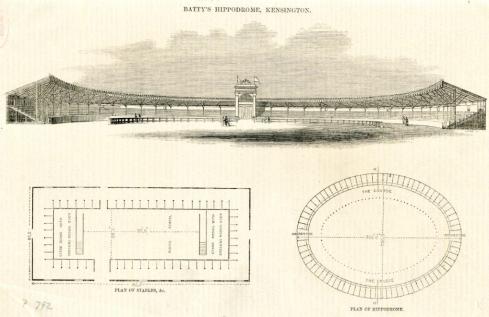
The handbills promised some marvelous equestrian and musical displays.
All set in a splendid new arena, built to contain these wonders.
Wednesday, 4 March 2020
March 1848
Looking for the date March 4 we found a story in our blog which happened in Leeds .
It is about the director of a circus Pablo Fanque
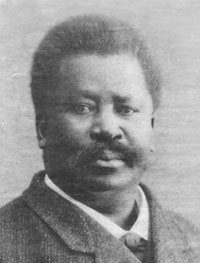
Pablo Fanque

After the disaster, Mr Harwood took the lease on the site and developed the Princess’s Theatre, where both variety concerts and occasional circus shows were given.
Years later a 4 March 1854 edition of the Leeds Intelligencer recalled the incident, while announcing the return of Pablo Fanque's Circus to Leeds:
"His last visit, preceding the present one, was unfortunately attended by a very melancholy accident. On that occasion he occupied a circus in King Charles's Croft and part of the building gave way during the time it was occupied by a crowded audience. Several persons were more or less injured by the fall of the timbers composing the part that proved too weak, and Mrs Darby, the wife of the proprietor, was killed. This event, which occurred on Saturday the 18th March 1848, excited much sympathy throughout the borough. A neat monument with an impressive inscription is placed above the grave of Mrs Darby, in the Woodhouse Lane Cemetery."
The reason he was already in the blog ,was that he performed in the Hippodrome on "the benefit of mr Kite" The Beatles made a song of that event .
John Lennon found an poster of this event in a shop.

The inspiration to write the song was a 19th-century circus poster for Pablo Fanque's Circus Royal appearance at Rochdale. Lennon purchased the poster in an antique shop on 31 January 1967, while the Beatles were filming the promotional films for "Strawberry Fields Forever" and "Penny Lane" in Sevenoaks, Kent.Lennon claimed years later to still have the poster in his home. "Everything from the song is from that poster," he explained, "except the horse wasn't called Henry."(The poster identifies the horse as "Zanthus".)
Mr. Kite is believed to be William Kite, who worked for Pablo Fanque from 1843 to 1845. "Mr. J. Henderson" was John Henderson, a wire-walker, equestrian, trampoline artist, and clown. While the poster made no mention of "Hendersons" plural, as Lennon sings, John Henderson did perform with his wife Agnes, the daughter of circus owner Henry Hengler. The Hendersons performed throughout Europe and Russia during the 1840s and 1850s.[
A hogshead is a large wooden cask.
The Hippodrome was owned by William Batty .
more on William Batty
Monday, 2 March 2020
The destruction of Magdalen Street Exeter
The destruction of Magdalen Street Exeter
Besleys’ Streets Directory of Exeter in 1906 has the entry:
33 Pyle, Charles William, shoeing forge
34 Stokes, William, Valiant Soldier Inn
Here is Holloway Street
This was the junction that we know from our post on Magdalen Street that
Thomas Joce identified as a corner on the former Saxon/Roman road just outside
the old South Gate of Exeter. Along both streets were handsome 1830s’ buildings
with ornate grey stucco* frontages, still very new when John Carpenter moved
into his premises some time in the 1840s. A photograph from the Express & Echo
newspaper in June 1977 shows that nos. 42–46 were pinkwashed and all still
had their elegant mouldings over the door and round the sash windows. But they
were derelict, and nos. 44–46 were about to follow no. 33, The Valiant Soldier,
and almost all of Holloway Street, into dust. They were, in David Pearce’s words,
‘inconveniently sited old buildings’ in the way of the development of the city.**
Much of Magdalen Street and Holloway Street had already been demolished in
1962 to facilitate a new ring road development, and nos. 44–46 went 15 years
later when the inner bypass was constructed, despite having (with nos. 42 and
43) been Grade II listed in June 1974 as ‘buildings of particular historical and
architectural interest’.
Pearce outlines the use of a ‘dangerous structure note’ (DNS), which could be
enforced if a building was thought structurally unsafe or unfit for human
habitation; but Magdalen/Holloway Streets had reached that condition only
through deliberate neglect of their fabric since 1945. They formed the last intact
part of the historical city landscape almost untouched by the May 1942 blitz;
apart from the Georgian estate there were timber-framed houses coeval with The
Valiant Soldier and Roman artifacts from the garrisons in the city and at
Topsham. When nos. 44–46 were torn down it was found that the 1830s’ stucco
exterior was a façade, behind which was the 1659 town house of the ‘common
councilman’ John Matthew, with intact seventeenth-century panelling, fireplaces
and stairs, one of the earliest brick and most architecturally important buildings
in the city.
In the same 1977 demolition, Magdalen House (nos. 39–40 Magdalen Street) was
lost, ‘another pointless casualty of the ... inner bypass’.*** This was the ‘smart
house’ of Dr Michael Lee Dicker, built around 1727. Dicker was born in Exeter in
1673 but became a student of Dr Herman Boerhaave in Leiden before setting up
his Exeter practice in 1718. Boerhaave (see later post) became known as ‘the
father of physiology’ and pioneered a clinical approach to medicine. Magdalen
House was a handsome three-storey brick building with a stucco façade and a
pediment frieze of shells, acanthus leaves and urns that in Jacqueline Warren’s
words was ‘unique to Exeter’. The frontage was completed by fluted pilasters
and Corinthian capitals and its original panelling and staircase were still in place
at the time of its demolition; it was thought important enough to be given Grade
II listed status as early as 1953 and was in reality not impacted by the bypass
and, with the properties on the north side of Magdalen Street between South
Street and the entrance to Southernhay, was needlessly destroyed.****
Thanks Barbara !
Sunday, 1 March 2020
John Carpenter of Magdalen Street Exeter
John Carpenter of Magdalen Street Exeter
John Carpenter (b. Teignmouth 1816), husband of Susanna Chamberlain (b.
Broadclyst 1822), worked as a blacksmith and farrier at 33 Magdalen Street in
Exeter; his business is listed in both Hunt & Co.’s Exeter, Bristol & Directory of
1848 and White’s Devonshire Directory of 1850.
John Carpenter (b. Teignmouth 1816), husband of Susanna Chamberlain (b.
Broadclyst 1822), worked as a blacksmith and farrier at 33 Magdalen Street in
Exeter; his business is listed in both Hunt & Co.’s Exeter, Bristol & Directory of
1848 and White’s Devonshire Directory of 1850.
We know he had least eight children: John Henry (b. 1849 in Teignmouth), Isabella (b. 1851, like all her younger siblings, in Exeter), Arthur Duncan (b. 1853), Julia (b. 1855), and then
Maria Margaret (b. 1860), Blanche (b. 1862) and Maud and Eva (b. 1864).
Maria Margaret (b. 1860), Blanche (b. 1862) and Maud and Eva (b. 1864).
John married in 1848, when Susanna was 26: it looks as if she, like her eldest sister
Charlotte, put off marriage until the income from her dressmaking had helped to
raise her eight younger Chamberlain siblings in Broadclyst.
John was the fifth child of Thomas Carpenter (b. 1776, a sawyer) and Esther
Towill Edwards (b. 1788*, a dressmaker), both of Teignmouth.
Charlotte, put off marriage until the income from her dressmaking had helped to
raise her eight younger Chamberlain siblings in Broadclyst.
John was the fifth child of Thomas Carpenter (b. 1776, a sawyer) and Esther
Towill Edwards (b. 1788*, a dressmaker), both of Teignmouth.
His eldest brother, Thomas Edwards (b. 1804) and his third brother Henry George
(b.1818) were both druggists (pharmacists/chemists); his fourth brother,
William Frederick (b. 1821) was a veterinary surgeon and his fifth,
Charles Francis (b.1823) a blacksmith, but by 1841 called an ‘assistant’, so possibly in a veterinary practice as well. Thomas Sr.’s family of eight was completed by three daughters
(Anna Maria, b. 1806, Eliza, b. 1811 and Sarah, b. 1813).
Unlike Charlotte in Cardiff, we cannot find Susanna running her own dress shop
in Exeter, but she could have been making clothes for a business in the town (and
at home after she married) – in Magdalen Street alone there was a stay maker**
at no. 48 and a straw hat maker at no. 26, as well as milliners at nos. 3, 17 and 20,
a hosier at no. 31 and tailors at nos. 13 and 25 (see separate post).
(Anna Maria, b. 1806, Eliza, b. 1811 and Sarah, b. 1813).
Unlike Charlotte in Cardiff, we cannot find Susanna running her own dress shop
in Exeter, but she could have been making clothes for a business in the town (and
at home after she married) – in Magdalen Street alone there was a stay maker**
at no. 48 and a straw hat maker at no. 26, as well as milliners at nos. 3, 17 and 20,
a hosier at no. 31 and tailors at nos. 13 and 25 (see separate post).
Until he settled in Magdalen Street John must have driven a horse and cart the 15 miles
north to Exeter from Teignmouth (although the railway came in 1846).
north to Exeter from Teignmouth (although the railway came in 1846).
In 1848 he was 34, so may have been a widower when he married Susanna.
She is still listed as a ‘farrier’s wife’ in the 1871 census, but is not present in 1881; John,
then aged 65, was employing two men, so the business was clearly flourishing,
and there is a census entry for 1901, when he would have been 85 or 86.
In the Post Office Directory of Exeter 1895–6, a John Carpenter (presumably
John’s son, John Henry, aged 44) is still at 33 Magdalen Street but now running a
‘veterinary forge’, so qualified to dispense medicine to and treat sick and lame
horses, not just shoe them. By 1906, no. 33 was again just a ‘shoeing forge’ with a
‘shoeing smith’ called Charles William Pyle, 30 in 1901 and possibly John Henry’s
son-in-law. In the 1911 census he is trading as ‘William Pyle & Co., blacksmith,
shoeing and general smith’, so financially secure enough to go into a partnership.
He almost certainly became an early automobile mechanic, as many blacksmiths
were forced to do as their trade contracted in the face of the mass production of
bicycles and cars and the decline in horse-drawn traffic; his business is still listed
in Besley’s Directory of Exeter & Suburbs 1916–19, so it survived the First World
War He seems to have had at least three children – two sons both called Charles
(b. 1891 and 1898, which implies that the elder son died) and a third son,
Edward Charles (b. 1901). If Charles William is indeed John Sr.’s grandson-in-
law, his business survived for at least 70 years, from a pre-industrial ‘cottage
industry’ to a place in the modern motor age.
* This may be an error, as if Esther was b. 1788 she would have been only 16
when Thomas was born; she seems not to be in the 1861 census.
then aged 65, was employing two men, so the business was clearly flourishing,
and there is a census entry for 1901, when he would have been 85 or 86.
In the Post Office Directory of Exeter 1895–6, a John Carpenter (presumably
John’s son, John Henry, aged 44) is still at 33 Magdalen Street but now running a
‘veterinary forge’, so qualified to dispense medicine to and treat sick and lame
horses, not just shoe them. By 1906, no. 33 was again just a ‘shoeing forge’ with a
‘shoeing smith’ called Charles William Pyle, 30 in 1901 and possibly John Henry’s
son-in-law. In the 1911 census he is trading as ‘William Pyle & Co., blacksmith,
shoeing and general smith’, so financially secure enough to go into a partnership.
He almost certainly became an early automobile mechanic, as many blacksmiths
were forced to do as their trade contracted in the face of the mass production of
bicycles and cars and the decline in horse-drawn traffic; his business is still listed
in Besley’s Directory of Exeter & Suburbs 1916–19, so it survived the First World
War He seems to have had at least three children – two sons both called Charles
(b. 1891 and 1898, which implies that the elder son died) and a third son,
Edward Charles (b. 1901). If Charles William is indeed John Sr.’s grandson-in-
law, his business survived for at least 70 years, from a pre-industrial ‘cottage
industry’ to a place in the modern motor age.
* This may be an error, as if Esther was b. 1788 she would have been only 16
when Thomas was born; she seems not to be in the 1861 census.
Subscribe to:
Posts (Atom)