Wednesday, 12 December 2012

Samuel and Ann Peel


name

Ann Peel
gender:Female
burial date:26 Oct 1853
burial place:Madras, Madras, India
death date:26 Oct 1853
death place:
age:38
birth date:1815
birthplace:
occupation:
race:
marital status:Widowed
spouse's name:Samuel Peel

name:Samuel Peel
gender:Male
burial date:18 Nov 1836
burial place:Nagpore, Madras, India
death date:
death place:
age:26
birth date:1810

Tuesday, 11 December 2012

Nathaniel and Constance Peel


The parents  of Reginald Peel were  Nathaniel Peel and Constance Amelia Bird,
Nathaniel Peel was born in Madras 1834
name:Nathaniel Peel
gender:Male
baptism/christening date:23 Jul 1834
baptism/christening place:Madras, Madras, India
birth date:15 Jul 1834

son of Samuel  and Ann Peel.
He married Constance Amelia Bird .
name:Constance Amelia Bird
gender:Female
baptism/christening date:28 Mar 1849
baptism/christening place:Byeullah, Bombay, India
birth date:25 Jan 1849
daughter of Thomas Bird and Catharina Eliza Anna 

Nathaniel and Constance Peel had several children .
name:Edith Peel
gender:Female
baptism/christening date:03 Aug 1868
baptism/christening place:Bombay, Bombay, India
birth date:14 Jan 1868


name:


Agnes Peel
gender:Female
baptism/christening date:15 Oct 1870
baptism/christening place:Poona, Bombay, India
birth date:28 Sep 1870

name:Reginald Peel
gender:Male
baptism/christening date:02 Mar 1873
baptism/christening place:Moradabad, Bengal, India
birth date:13 Feb 1873

name:Clifford Peel
gender:Male
baptism/christening date:15 Jun 1874
baptism/christening place:India
birth date:19 May 1874
birthplace:Sealkote Bengal India


groom's name:Nathaniel Peel
groom's birth date:1834
groom's birthplace:
groom's age:21
bride's name:Maria D'Reys
bride's birth date:1836
bride's birthplace:
bride's age:19
marriage date:04 Jul 1855
marriage place:Vepery, Madras, India
groom's father's name:Samuel Peel
groom's mother's name:
bride's father's name:Joseph D'Reys
bride's mother's name:
groom's race:
groom's marital status:Single
groom's previous wife's name:
bride's race:
bride's marital status:Single

groom's name:Nathaniel Peel
groom's birth date:
groom's birthplace:
groom's age:
bride's name:Eliza Lamaury
bride's birth date:
bride's birthplace:
bride's age:
marriage date:11 Jun 1856
marriage place:Madras, Madras, India
groom's father's name:Samuel Peel
groom's mother's name:
bride's father's name:Thomas Rodrigues
bride's mother's name:
groom's race:
groom's marital status:
groom's previous wife's name:
bride's race:
bride's marital status:Widowed


groom's name:


Nathaniel Peel
groom's birth date:
groom's birthplace:
groom's age:
bride's name:Constance Amelia Bird
bride's birth date:
bride's birthplace:
bride's age:
marriage date:14 Sep 1866
marriage place:Poona, Bombay, India
groom's father's name:Samuel Peel
groom's mother's name:
bride's father's name:Thomas Bird
bride's mother's name:
Photo of Nathaniel Peels stamp or small coin Wallet


more on this family 

Eliza Peel

name:Eliza Peel
gender:Female
burial date:23 Mar 1882
burial place:Pursewalkum, Madras, India
death date:23 Mar 1882
death place:
age:56
birth date:1826
birthplace:
occupation:
race:
marital status:Widowed
spouse's name:Nathaniel Peel

Monday, 10 December 2012

search

After 588 articles and more then 32000 pageviews even I get  lost in the blog .

But by using the search option in the left hand corner ,it is a piece of cake to find what you are looking for.


Saturday, 8 December 2012

D.C.Carr


We wrote about Daniel Carr and his school in Fakenham and his assistent teacher at the time Jerome Nicholas Vlieland.
Here the complete inscription of his book about Linnaues ,dedicated to his son .


My Dear Boy, I Know no one more worthy of the respect which the dedication of a book implies than yourself. Although now only eleven years old, you have already been a source of pure delight and satisfaction , to me, and your affectionate mother. ;vWell do I remember the time, when your ^. vain attempts to articulate the simplest 'words of your native tongue, used to excite our mirth by their failure. From f/)that time to the present, I have ever > found you most obedient, teachable, and i;j eager to profit by instruction. I say not"J this with a view to render you vain in your own eyes—for I trust you will al^, ways well reflect, that " every good gift, and every perfect gift is from above, and
cometh down from the Father of lights" —but I mention it to encourage you in your future progress. Persevere, my child, in the path of knowledge and virtue; and if it please God to prolong your life to man's estate, let it be your main object to render yourself serviceable to your fellow-creatures, and thus profitably employ the talent committed to your care.

You are aware, that it is my intention almost immediately to instruct you in the delightful science of botany. I have waited only until you should be sufficiently acquainted with the Latin and Greek languages, to enable you to pursue it with accuracy, and an enlightened perception of its principles; for although such a preparatory knowledge is not absolutely necessary to form a botanist, it is attended with many decided advantages. To explain to your youthful mind every particular on this head would be needless—I shall merely observe, that most of the terms used in this, as well as
in every other science; are derived from those languages; and that to every plant, in the classification of Linnaeus, are allotted two names, which it requires a knowledge of syntactical construction to express correctly.

This first step you have happily accomplished, and may now enter upon the study with a probability of success. I promise myself much happiness in guiding your early progress, but, if I divine aright, you will soon be enabled to pursue your inquiries without my assistance; for so fascinating and easy is this science, after the elementary principles have been properly explained, and so connected are its various parts, that an intelligent and discriminating pupil will find much of his labour anticipated, by the acquisition of some previous fact.

Let the example of the great Linn^us stimulate you to perseverance. The first thought which occurred to me of dedicating this little book to you, was suggested, by an admiration of that great man's juvenile powers of observation, and the habit of method which characterized every period of his life. Imitate him in all the virtues he possessed, and shun his failings. If with such a spirit you devote yourself to this beautiful study, I feel an assured conviction that it will have the effect on your mind which I earnestly desire—namely, a veneration of the wisdom and benevolence of the Creator, and a fixed resolution to obey his commands. I am,

MY DEAR BOY,

Your most affectionate Father,

DANIEL C. CARR.

Fakenham,

January, 1837.

Friday, 7 December 2012

APPRECIATION BY THE SECRETARY FOR DEFENCE, MALAYA’


Louis Allen’s uncorrected proof of his “Singapore 1941-1942” and I was truly amazed by much of it and especially by the:--     
    ‘APPRECIATION BY THE SECRETARY FOR DEFENCE, MALAYA
                              (C.A. Vlieland.)  July 1940.
               [Appendix III in Allen ( op. cit. pp. 288-293)] Anyone who pretends even a passing interest in this period of our history must read and absorb Vlieland’s incredibly prescient assessment of the vital importance of the (then) Malayan Peninsular in the event of the need to defend Malaya, which of course included Singapore. Vlieland is (in my opinion, overly) generous in attributing to the then G.S.O. I (Col. Percival) in 1937 “ an appreciation which stressed the probability of the Japanese making use of territory in Southern Siam and the importance of defending northern Malaya.” (p. 289). That appreciation, if made, must have been in the first of the two lectures given to MALAYA COMMAND in January 1937.

The second, and published, lecture was:--

           ‘THE STRATEGICAL PROBLEMS OF SINGAPORE
                           (A.E. Percival.)  January 1937.     
                  [Appendix II in Allen (op. cit. pp.272-287)

There is no mention of either ‘Southern Siam’ or ‘northern Malaya’ in that second Percival lecture: indeed, the prevailing sentiment is  “Consequently, the principal object of the defence of Singapore is to protect the Naval Base here against attack until the arrival of the British Main Fleet and to afford security to our forces’ ( ? prior and ) ‘subsequent to its arrival.” (p. 281).
                            
        Secondly. Given that Vlieland had exposed the dangers to Singapore by enemy attacks in Southern Thailand and northern Malaya thereby giving an enemy access to the west coast of the Malayan Peninsular, a counter strategy known as ‘Operation Matador’ was devised. (see Allen op.cit. pp.92-115.) Matador was intended to prevent an enemy from gaining access to Southern Thai airfields at, for example, Singora and Patani. Matador was never activated even though it was known that the Japanese ‘Malaya Force’ had left Hainan on 4 December 1941.(p.101). I believe the explanation to be that the British had been bluffing for years and had fallen for their own propaganda of their invincibility. Unfortunately for many, they (the British) were now to be pitted against another equally arrogant self-perceived master race, the Japanese.
         There are of course many other facets of the WHY question but once the usual inaction led to ‘not to Matador’ (ie. not to invade Southern Thailand in order to attempt to secure the Kra Isthmus against the Japanese.) then Malaya, including Singapore, was lost to Yamashita and Tsuji as I shall attempt briefly to explain in my addressing of the HOW question.
         In addressing the question HOW, it is vital to re-identify TSUJI and to recall his remarkable and seminal role in the planning and executing of the Malayan Campaign. [It is idle but nevertheless tempting to reflect, even if only momentarily, upon the outcome in the ‘Far East’ if Tsuji had been on our side.]   
         I have already (see TIMOR p. 2) identified Tsuji (his family name) as the Director of Planning and Operations Staff of the Malayan Campaign under General Yamashita Commander of the 25th. Japanese Army. (That Army was composed of 3 Divisions:-- the 5th., the 18th. and the Imperial Guards Divisions.)
         Tsuji seems to have escaped the attention of most writers although Legg ( op.cit. p. 210) records Tsuji’s acknowledgement that the Australian 8th Division at Gemas fought, under Gordon Bennett, “with a bravery we (Japanese) had not previously seen” and “completely changed the aspect of the combat zone.” Until Gemas (which is about 2/3rds down the Malayan Peninsular), Yamashita had been able to do almost as he wished, the Japanese advancing at the rate of about 20 km. per day with repeated, morale destroying withdrawals by 2 British Indian Divisions, 3 British Indian Brigades, 2 Malay Volunteers Brigades and 2 British Army Brigades

Thursday, 6 December 2012

Jerome Nicholas

Today the names Jerome Nicholas explained.
Jerome (given name)
From Wikipedia, the free encyclopedia
Jerome
Gender male
Origin
Word/Name Greek
Meaning "sacred name"

Look up Jerome in Wiktionary, the free dictionary.

Jerome is a masculine name of Greek origin, derived from the Greek given nameἹερώνυμος, Hierōnymos, "sacred name"; from ἱερός, hierós, "sacred", and ὂνυμα, ónyma, an alternative form of ὄνομα, ónoma, "name".
It is the name of a prominent Christian saint, Saint Jerome[1], the translator of the Vulgate.
Jerome ranked among the top 200 names given to boys born in the United States between 1903 and 1985. It has since declined in popularity and was ranked as the 616th most popular name for American boys born in 2008.[2]
Variants
Gerolamo Italian
Gerome English
Geronimo Italian
Girolamo Italian
Hieronymos Greek
Hieronymus Latin and German
Iarom Irish
Ieronimus Medieval Latin
Jeroen Dutch
Jerome English
Jérôme French
Jerónimo Spanish
Jerônimo Portuguese[3]
Xerome, Xeromo, Xerónimo Galician
Yaron (ירון) Hebrew
[edit]Notes

^ http://www.behindthename.com/name/jerome
^ http://www.socialsecurity.gov/cgi-bin/babyname.cgi
^ http://www.behindthename.com/php/related.php?name=jero13nimo

Nicholas
From Wikipedia, the free encyclopedia
For other uses, see Nicholas (disambiguation).
Nicholas
Gender Male
Origin
Word/Name Greek
Meaning Victory of the people
Other names
Nickname(s) Nick, Nicky, Nic, Nik
Derived Νικόλαος (Nikolaos), a combination of Greek words "Victory" (Νίκη; nikē) and "People" (λαὸς; laos)

Look up Nicholas in Wiktionary, the free dictionary.

Nicholas
Miklos
Mikołaj
Mikuláš
Nicola
Nicolas
Nicolau
Nicolay
Niccolò
Nikola
Nikolay
Nikolaj
Klaus
Nick
Nico


Nicholas or Nikolas is a male given name, derived from the Greek name Νικόλαος (Nikolaos), a combination of the words for "victory" (νίκη; níkē) and "people" (λαὸς; laós). The name can be understood to mean victory of the people. In addition, "laos" or "λαὸς" in Greek, originates from the word root "-las", as found in the word "λα-τομεῑο" meaning "stone" or "rock" (in Greek Mythology, Deucalion and Pyrrha recreated the people after they had vanished in a catastrophic deluge, by throwing stones behind their shoulders while they kept marching on). The name became popular through Saint Nicholas, Bishop ofMyra in Lycia, the inspiration for Santa Claus. The customary English version of spelling "Nicholas", using an "h", first came into use in the 12th century and has been firmly established since the Reformation, though "Nicolas" is occasionally used. In 2006, Nicholas – and its variations – was the 17th most popular male name given to babies in the USA. Roughly 0.7151% of the baby boys born that year, or 15,414, were given that name. It is decreasing in popularity, from a high in 1997, when 27,248 US males were given the name Nicholas. That year was the most popular year for Nicholas since 1880, when U.S. records were kept for given names.[1]

The Eastern Orthodox Church, the Roman Catholic Church, and the Anglican Churchescelebrate Saint Nicholas every year on December 6, which is the name day for "Nicholas". In Greece, the name and its derivatives are especially popular in maritime regions, as St. Nicholas is considered the protector saint of seafarers.


Contents [hide]
1 Male variations
2 Female forms
3 People known as Nicholas
3.1 Saints
4 See also
5 References

[edit]Male variations

Variations for males include[2][3]:
Albanian: Nikollë, Nikolla, Nikollai, Nikë, Niklaus, Klaus, Koll, Kolë
Arabic: نقولا‎
Basque: Nikola
Belarusian: Mikalai (Мікалай), Mikola (Мікола)
Bulgarian: Никола (Nikola), Николай (Nikolay), Никлен (Niklen), Никулица (Nikùlitsa), Коле (Kole), Кольо (Kolyo), Колю (Kolyu)
Catalan: Nicolau
Chinese: 尼古拉斯 (Nígǔlāsī)
Croatian: Nikola, Nikula, Mikola, Mikac, Mika, Nikić, Niko, Mikula
Czech: Mikoláš, Mikuláš, Nikola
Danish: Claus, Klaus, Niels, Nicolai, Nikolaj, Nilas, Nis, Nikolas, Nikolai, Nicklas, Niklas
Dutch: Nicolaas, Nikolaas, Klaas, Nico, Niek, Niels
English: Nicholas, Nikolas, Colin
Esperanto: Niĉjo, Niko, Nikolao
Estonian: Nigul
Fijian: Niko
Finnish: Launo, Niilo, Niklas, Niko, Nikolai
French: Nicolas, Nico, Colas, Colin
Galician: Nicolao
Georgian: ნიკოლოზ (Nikoloz), ნიკა (Nika), ნიკო (Niko), კოლაუ (Kolau)
German: Claus, Claas, Klaas, Klaus, Klas, Nickolaus, Nicolas, Nicolaus, Niklaus, Nikolaus, Nikolo, Niklas, Nico, Niko
Greek: Νικόλαος (Nikolaos), Νικόλας (Nikolas), Νίκος (Nikos), Νικολής (Nikolis), Νικήτας (Niketas)
Hungarian: Miklós, Nikola, Nyikoláj
Irish: Nioclás
Italian: Niccolò, Nico, Nicola, Nicolò, Nicolas
Japanese: ニコラス (Nikorasu)
Korean: 니콜라스 (Nikollaseu)
Latin: Nicolaus
Latvian: Nikolass, Nikolajs, Niks
Lithuanian: Mikalojus
Leonese language: Nicolás, Nicu, Colás
Low German: Nikolaas, Nicolaas, Klaas, Klaus
Macedonian: Никола (Nikola), Коле (Kole), Кољо (Koljo), Николче (Nikolče), Николе (Nikole)
Malay: Nikk
Norwegian: Nils, Nikolai
Polish: Mikołaj, Mik, Mikołajek
Portuguese: Nicolau, Nicolas
Romanian: Neculai, Nicolae, Nicu, Nicușor, Niculae
Russian: Николай (Nikolai), Коля (Kolya)
Scottish Gaelic: Neacel, Nichol, Nicol, Caelan, Calen
Serbian: Никола/Nikola, Николај/Nikolaj, Никодије/Nikodije, Никодим/Nikodim, Никодин/Nikodin, Кода/Koda, Коле/Kole,Никша/Nikša, Николица/Nikolica, Никшица/Nikšica, Нико/Niko, Никица/Nikica
Slovak: Mikuláš, Nikola, Mikoláš
Slovene: Miklavž, Niko, Nikolaj
Spanish: Nicolás, Nicolao
Swedish: Nels, Niklas, Niclas, Nicklas, Nils, Klas, Claes
Turkish: Nikola
Ukrainian: Микола (Mykola), Миколай (Mykolai)
West Frisian: Klaes
[edit]Female forms

Female forms include[2]:
Bulgarian: Николина (Nikolina), Николета (Nikoleta), Никол (Nikol), Нина (Nina)
Croatian: Nikolina, Nika, Nina
Czech: Nikol, Nikoleta, Nikola, Nicol
Dutch: Klasina, Klazina, Nicole, Nicolien, Nicolet, Nicoline
Danish: Nikoline
English: Nicole/Nichole/Nicolle/Nikole/Nikkole, Nicola/Nichola, Nicolette, Colette, Nicki/Nicky/Nikki/Nicci
French: Colette, Coline, Nicole, Nicolette, Nicoline
German: Nicole, Nikole, Nicola, Nikola
Greek: Νίκη (Níkē, a conflation with Níke), Νικολέτα (Nikoléta), Νικολίνα (Νikolína)
Hungarian: Nikolett
Italian: Nicoletta, Nicola, Nicole, Nicolina
Macedonian: Nikolina
Norwegian: Nilsine, Nicoline
Portuguese: Nicole
Romanian: Niculina, Nicoleta, Nicolina, Nico
Scottish: Nicola
Serbian: Nikolija (archaic), Nikolina, Nikoleta
Slovak: Nikola, Nikoleta
Slovene: Nika
Spanish: Nicolasa, Nikoletta, Nicolá
Turkish: Nikol
[edit]People known as Nicholas
Nicholas of Cusa
Nicolas Flamel, famous alchemist
Nicholas I of Montenegro, King of Montenegro
Nicholas I of Russia
Nicholas II of Russia
Nicholas of Tolentino
Prince Nicholas of Romania (1903–1978)
Nicholas is also the name of five popes (Pope Nicholas I, Pope Nicholas II, Pope Nicholas III, Pope Nicholas IV, and Pope Nicholas V), Antipope Nicholas V and four Patriarchs of Constantinople of which best known are Nicholas Mystikos, and Nicholas III Grammatikos
Nicholas Briggs (born 1961), British actor known as the voice of the Daleks on Doctor Who
Nicholas "Nick" Clegg (born 1967), British politician
Nicholas Scott Lachey (born 1973), American singer, songwriter, actor, producer, and television personality
Nicholas Mosley (born 1923), British novelist and aristocrat
Nicholas Patrick (born 1964), British-American engineer and astronaut
Nicholas Pegg, British actor, director and writer
Nicholas Charles Sparks (born 1965), American novelist, screenwriter
Nicholas Sparks (politician) (1794–1862), American politician
Nicholas Tse (Chinese: 謝霆鋒, born 1980), Hong Kong singer and actor
[edit]Saints
Saint Nicholas The Duc Bui, one of the Vietnamese Martyrs
Saint Nicholas of Flue
Saint Nicholas of Japan
Saint Nicholas of Myra, also known as Sinterklaas

[edit]

Wednesday, 5 December 2012

Saint Nicholas day 5 December

Today is the day we have been waiting for the birthday of Saint Nicholas.
In Dutch tradition we are all anxious what he has to solve this time.
The television shows us the latest problems every day.
always troubles........his horse is sick ....lost.....homesick.
his steamer is lost , broken , still in Spain , in a storm.
Black Peter ....lost , sick , homesick ,in a storm .
It never is without troubles, sorrow and hardship.
But in the end all is well.
Everyone will get a present and a rhyme.
In the rhyme is explained why this gift is so special and just for you.
It zooms in to all your faults and mistakes you made this last year .
It is presented in the dark on your doorstep..... .with a big bang on the door or a rattle on a window and no one to be seen..........No neighbor (as he ducks away behind the hedge ), not your friend (who runs back to his car......
You yell `Thank you Sinterklaas` and bring the bag in to unwrap and to read your rhyme.
You drink your hot chocolate and eat your special candy and enjoy the day.
And Sint he will go back with his steamer ,black Pete´s and horse to Madrid.
And next year there will be problems , rhymes and presents all over again.
and sometimes it even gets worse like these bloopers.


Our Jerome Nicholas is named after two saints .Saint Jerome and Saint Nicholas.
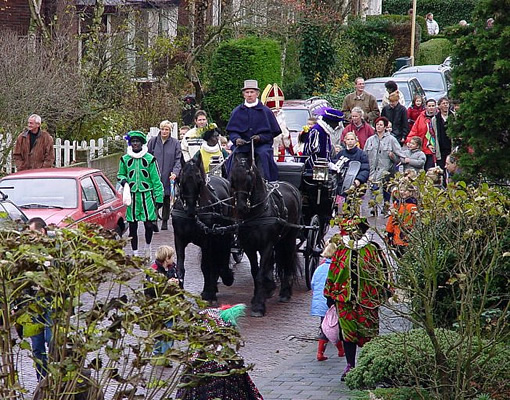
In mid-November Dutch television broadcasts the official arrival of St. Nicholas and his helper Zwarte Piet live to the nation. Coming by steamer from Spain, each year they dock in the harbor of a different city or village. Wearing traditional bishop's robes,Sinterklaas rides into town on a white horse to be greeted by the mayor. A motorcade and a brass band begin a great parade which leads Sinterklaas and his Piets through the town.


Sinterklaas Arrives in Castricum, the Netherlands Photo: P Van Trigt
Used by permission


Nearly every city, town and village has its own Sinterklaas parade. He usually arrives by horseback, but occaisionally he comes by boat, carriage, moped, or helicopter.


In the following weeks before St. Nicholas Day, December 6, Sinterklaas goes about the country to determine if the children have been well-behaved. He and his Zwarte Piet helpers visit children in schools, hospitals, department stores, and even at home. Bakeries are busy making speculaas, molded spice cookies, for the season.


During this time children sing Sinterklaas songs and put their shoes next to the window or door, or, by the fireplace or heater, along with a nice drawing, a wish-list and a carrot or hay, and maybe a saucer of water, for the horse. If St. Nicholas happens by while checking on their behavior, the next morning children may find chocolate coins or initial letter, candy treats, pepernoten, and little gifts in their shoes. Everyone hopes for sweets, not coal or a little bag of salt. In some families he may stop by every night, but usually just once or several times—and not if the children have been naughty that day or forgot to sing their songs!


The Dutch celebrate Sinterklaas on December 5th, St. Nicholas Eve, with festive family parties when gifts and surprises are exchanged. In the Netherlands, unlike other places, adults as well as children join in the fun. As the Dutch like an element of surprise, a small gift may be wrapped in a huge box, or it may be hidden and require following clues to discover where it is.


Shop windows are filled with Sinterklaas, toys and gifts
Photo: J M Rosenthal/SNS
Used by permission


Gifts are prettily wrapped in special Sinterklaas paper or they may be hidden, for example, in a potato or an old sock. Each gift, anonymously signed "from Sinterklaas," comes with a clever rhyme that may point out a person's shortcomings in a humorous way. (For the less creative, there are books with suggestions for making rhymes and packaging disguises.) Originality, not value of the gift, is what counts.


Children sing traditional Sinterklaas songs while waiting for the saint to appear. A knock comes on the door and a black gloved hand appears to toss candies and pepernoten inside. Children scramble to gather up the treats. A large burlap bag, "de zak van Sinterklaas," also appears filled with gifts. At the table, decorated with speculaas and other sweets, guests may find their initial in a chocolate letter at their places. Food is apt to include hot chocolate, Bishop's wine, and letter banket.


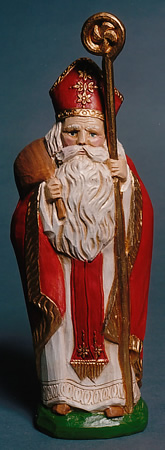
Sinterklaas, designed by Ron Hendriks
St Nicholas Center Collection


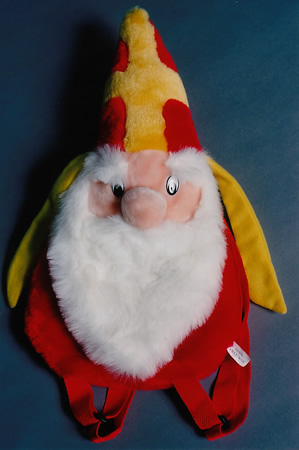
Child's Sinterklaas Backpack
St Nicholas Center Collection


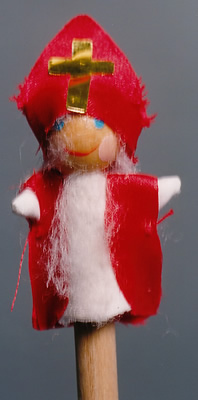
Dutch Pencil Topper
St Nicholas Center Collection


The Dutch feast of Saint Nicholas is about giving, for "it is in giving that we receive." The fun is in trying to surprise people, to tease in a well-meaning way, to make a good joke, to produce a rollicking rhyme. The gift itself is just a bonus, as the fun is in the doing.


Sinterklaas is the most important tradition for the Dutch, a 2008 Centre for Dutch Culture survey found. Celebrated the evening of December 5 with traditional tasty foods, it is the main time for family gift-giving. The second ranked tradition is decorating a Christmas tree, followed by Queen's Day, April 30. Blowing out birthday candles and eating raw herring were also in the top ten.


Dutch Sinterklaas Surprises

These are no ordinary presents!

Sinterklaas Comes to Texel

Sinterklaas—One Family's Experience

Living in the Netherlands, emigrating to the USA

Sinterklaas Official National Entry—with Photos

2012: Official National Entry in Roermond, Saturday, November 17, will be telecast live on Dutch national television.

Sinterklaas Arrival in Amsterdam

2011: Sinterklaas will arrive in Amsterdam on Sunday, November 13

Dutch Chocolate Letters
Sinterklaas Goes Green! De Groene Sint Deventer—A Unique Sinterklaas TraditionMore Sinterklaas Visits in the Netherlands

Saintly and Generous: Saint Nicholas and the Low Countries

How Sinterklaas traditions developed

Six to Eight Black Men by David Sedaris

An American humorist tries to understand Dutch Sinterklaas traditions

"Sinter Claes" in Amsterdam

The iconic stone tablet in Dam Square

American G.I.s Assist Sinterklaas

A true story from World War II

Airplanes, not by Steamboat

The RAF plays Sinterklaas

Sinterklaas op bezoek

Exhibit at Museum Catharijneconvent Utrecht

St. Nicholas Monuments in the Netherlands

Statues and images in public places


Links

List of Sinterklaas Arrivals, many with web links

An interesting Dutch Sinterklaas site, with information and many images

Dutch Sinterklaas Wrapping Paper, featuring Madelein Duijvestijn's collection of around 4300 giftwraps

Monday, 3 December 2012

Bernard Rickman Shillitoe


Bernard Shillitoe is born 29 April 1882. and is the son of Richard Shillitoe  and Mary Heath Vlieland .


census 1901


He died in 1953.
Here he is sitting on his mothers lap.

Sunday, 2 December 2012

Violet Mary Shillitoe.


Violet Mary Shillitoe is the daughter of Richard Shillitoe  and Mary Heath Vlieland .
She was born 1 March 1879

census 1901

She died Sep 1920 at the age of 40
married  Cecil Herbert Winter  Page in  December 1909 in  Hitchin .
He was born March 1879 Norwich.son of John and Elizabeth Page He died 1951 .
Their children :
1.Philip Raynold Page Born March 1914 Smallburgh.and he died in 1994 in Norfolk 
He married Ruth Eleanor Frances Hicks 13 August  1941 Ripon Yorkshire.
2.John F. Page Born Dec 1916 E.Preston.


census 1911.
Her mother is living there.


Church History

Page, Cecil Herbert Winter
The story of St. Nicholas' Church (formerly dedicated to the Blessed Virgin Mary) North Walsham, Norfolk.
[North Walsham, Rounce and Wortley, 1947]

Illustrated by Cecil Herbert Winter Page
family tree on Ancestry
PAGE, CECIL HERBERT WINTER. Adm. pens, at Corpus 
Christi, Oct. 1, 1896. [4th] s. of Charles Fountain, merchant, 
of Heigham Cottage, Norwich. B. there, Jan. 4, 1879. School, 
Norwich Grammar. Matric. Michs. 1896; Scholar, 1896; 
B.A. 1899; M.A. 1903; B.Chir., 1906; M.D., 1909. At 
St Bartholomew's Hospital. M.R.C.S.; L.R.C.P., 1904. 
House Surgeon, Stamford and Rutland General Infirmary. 
Practised at North Walsham, Norfolk. Served in the Great 
War, 1914-19 (Capt., R.A.M.C.). F.S.A. Member of Council 
of Norfolk and Norwich .\rchaeological Society. Hon. Sec, 
Norfolk Record Society. Of The Grange, North Wsilsham. 
Died Oct. 24, 1951. Brother of Reginald C. (1891). (Medical 
Directories.) 

Ex-M.C.S.


The Straits Times, 20 March 1947, Page 9
EX-M.CS. OFFICER'S NOVEL