Thursday, 5 March 2020

William Batty and his Hippodrome

BATTY'S HIPPODROME

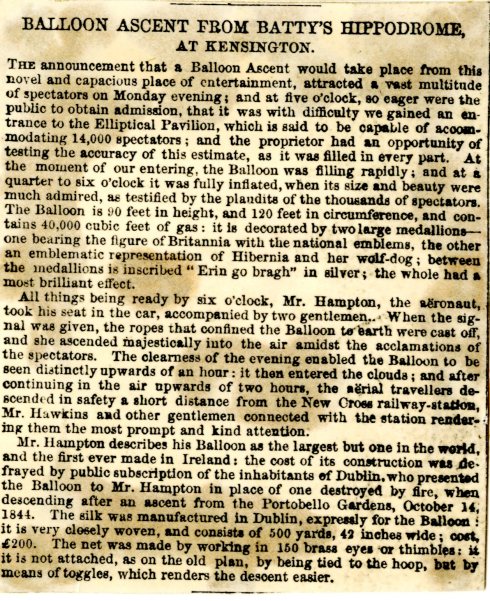
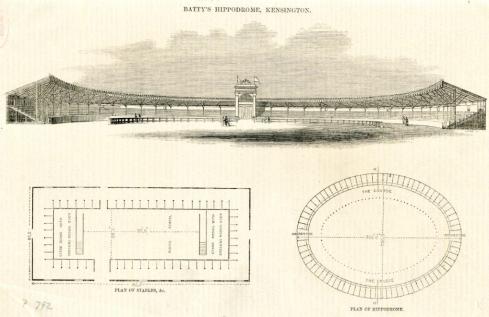
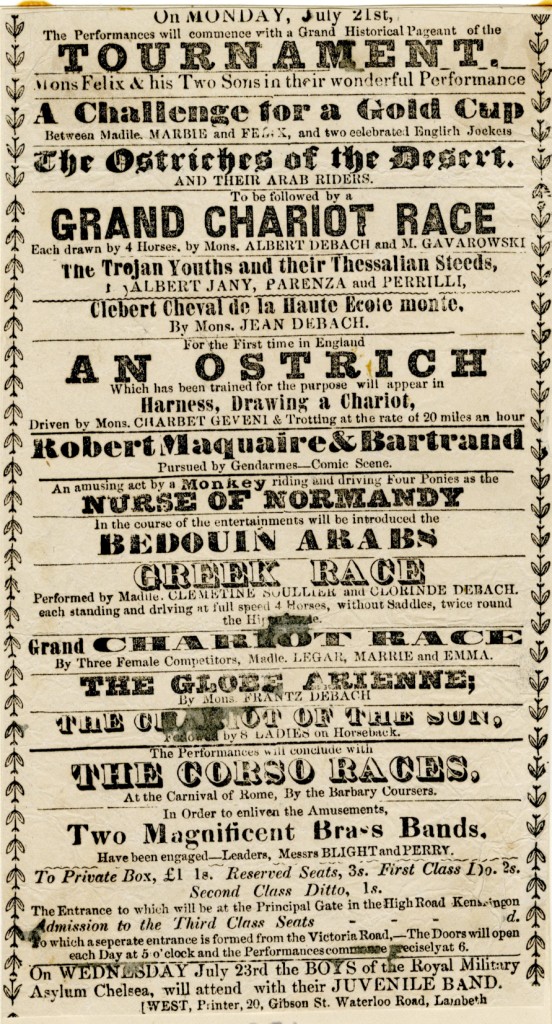
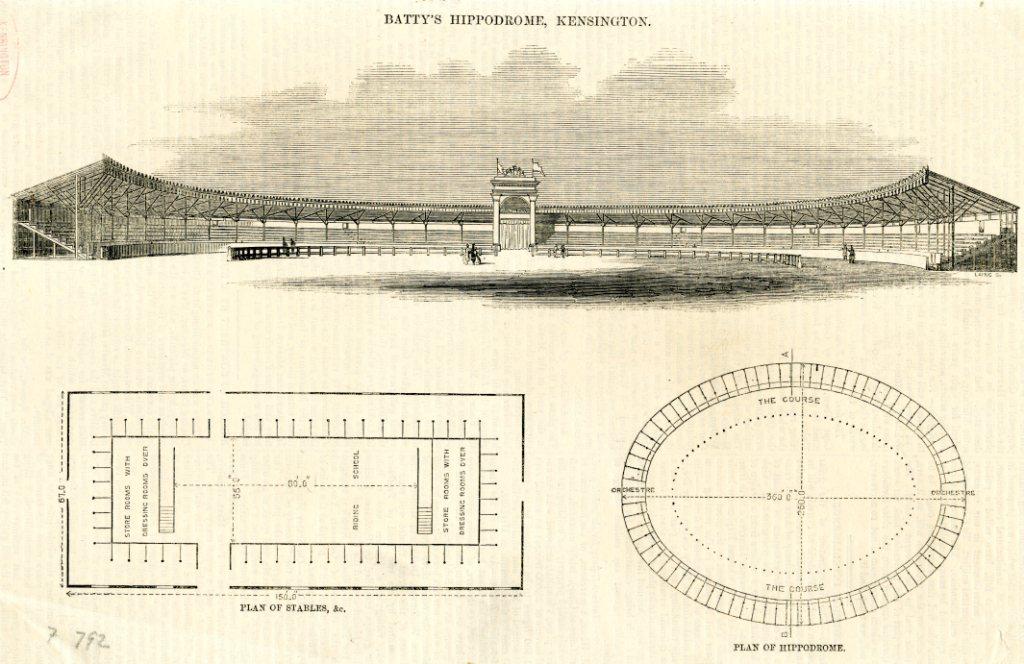
WITHIN five minutes' walk of the Crystal Palace, Mr. Batty has erected a novel kind of circus, calculated to be a rival to his own Astley's, but for the difference of locality and aim. Opposite the Broad-walk, Kensington Gardens, an amphitheatre of enormous dimensions, under the title of "the Hippodrome," attracts all lovers of horsemanship. It consists of a circle of boxes and stalls divided by two opposite orchestra stations, which are occupied by two brass bands, who continue playing during the performance and an hour previous. The seats for the audience are covered, but the arena for Equestrian exhibition is open to the air and sky. We are thus carried back to the ancient times of Greece and Rome, and our own Elizabethan era; and the entertainments are suitable to these classical associations. Tournaments, chariot races, Trojan youths and Thessalian steeds, and such reproductions from the days of old, are the prevailing amusements. We believe, indeed, that the bills attempt no delusion in stating, that these exercises are "on a scale of extent and grandeur hitherto unattempted in England." The artists have been drafted from the Hippodrome at Paris, the principal being M. Louis Soullier, equerry to his Highness the Sultan Medjid of Turkey and the Emperor of Russia, and "his numerous and highly-trained stud of horses" to whom may be added his company. The performance on Wednesday commenced with a pageant representing the meeting of Henry VIII. and Francis I. on the Field of the Cloth of Gold . . . The second part was not less interesting. The Brazilian coursers, performed by the three brothers Debach, on four horses each, was a highly exciting scene - presenting a trial of skill emulously carried out. But this was exceeded in interest by that exhibited by three female competitors, in a grand chariot race. The performances concluded with a monkey riding and driving four ponies; dames of the chase, in characteristic costume, on leaping palfreys; M. Frantz Debach, on the glove arienne, a well-known but difficult feat, and in this instance executed with inimitable grace; and the Corso races by Barbary coursers, as exhibition at the Carnival of Rome. We have omitted to mention an exceedingly amusing race by two ostriches of the desert, with their Arab riders, one of whom was thrown in the experiment.
Illustrated London News, Jan.-June, 1851  


BATTY'S HIPPODROME

In the autumn of 1850, William Batty, a famous circus proprietor, acquired some land within five minutes walk of the new world-wonder, the 'Crystal Palace,' and erected thereon an elliptical-roofed pavilion which accommodated many thousands of spectators, and had a large arena open to the sky.
The Royal Hippodrome was opened in May 1851 with a French troupe brought over from the Hippodrome at Paris. The performances generally took place in the evening, and the lowest price of admission was sixpence. Two brass bands of a rather blatant character enlivened the proceedings. Favourite features of the entertainment were a Roman chariot race and a 'triumphal race of the Roman consuls', who were represented by the three brothers Debach, each guiding six horses. . . . Other attractions were balloon ascents, and F.Debach's journey on the Arienne Ball up and down a narrow inclined plank.
The Hippodrome closed with the [Great] Exhibition and only lived for one other season in 1852. Subsequently in the sixties it was used as a riding school. The site lay nearly opposite the broad walk of Kensington Gardens, between part of Victoria Road and Victoria Walk and the present Palace Gate. De Vere Gardens mainly occupy the site.

Warwick Wroth, Cremorne and the later London Gardens, 1907


The handbills promised some marvelous equestrian and musical displays.


All set in a splendid new arena, built to contain these wonders.


Wednesday, 4 March 2020

March 1848

Looking for the date March 4 we found a story in our blog which happened in Leeds .
It is about the director of a circus Pablo Fanque

Pablo Fanque.jpg
Pablo Fanque 

During an evening performance in March 1848 a terrible accident occurred. The wooden beams supporting the gallery collapsed and the circus collapsed inwards. Panic ensued, with people spilling out into the narrow lanes surrounding the Croft. Many were injured, and Pablo Fanque searched the building looking for survivors. He discovered the only fatality of the night – his wife! She had been working in the box office directly beneath the gallery. She was buried a few days later, with great ceremony and thousands lined the streets of Leeds to watch the cortege pass. She was buried in the Woodhouse Lane cemetery (now St George’s Fields, part of the University of Leeds campus). When Pablo Fanque died in 1871 he instructed that his body be returned to Leeds and buried at the foot of his wife’s grave. Their headstones can still be seen today. 


After the disaster, Mr Harwood took the lease on the site and developed the Princess’s Theatre, where both variety concerts and occasional circus shows were given.


Fanque married Susannah Marlaw, the daughter of a Birmingham buttonmaker. They had two sons, one of whom was named Lionel. On 18 March 1848, his wife died in Leeds at an accident in the building where the circus was performing. Their son was performing a tightrope act before a large crowd at the Amphitheatre at King Charles Croft. The 600 people seated in the gallery fell with its collapse, but Susannah Darby was the only fatality. Heavy planks hit her on the back of the head. Reportedly, Fanque sought medical attention for his wife at the King Charles Hotel, but a surgeon pronounced her dead.

Years later a 4 March 1854 edition of the Leeds Intelligencer recalled the incident, while announcing the return of Pablo Fanque's Circus to Leeds:

"His last visit, preceding the present one, was unfortunately attended by a very melancholy accident. On that occasion he occupied a circus in King Charles's Croft and part of the building gave way during the time it was occupied by a crowded audience. Several persons were more or less injured by the fall of the timbers composing the part that proved too weak, and Mrs Darby, the wife of the proprietor, was killed. This event, which occurred on Saturday the 18th March 1848, excited much sympathy throughout the borough. A neat monument with an impressive inscription is placed above the grave of Mrs Darby, in the Woodhouse Lane Cemetery."

The reason he  was already in the blog ,was that he performed in the Hippodrome  on "the benefit of mr Kite" The Beatles made a song of that event .
John Lennon found an poster of this event in a shop.
                                                        

The inspiration to write the song was a 19th-century circus poster for Pablo Fanque's Circus Royal appearance at Rochdale. Lennon purchased the poster in an antique shop on 31 January 1967, while the Beatles were filming the promotional films for "Strawberry Fields Forever" and "Penny Lane" in Sevenoaks, Kent.Lennon claimed years later to still have the poster in his home. "Everything from the song is from that poster," he explained, "except the horse wasn't called Henry."(The poster identifies the horse as "Zanthus".)

Mr. Kite is believed to be William Kite, who worked for Pablo Fanque from 1843 to 1845. "Mr. J. Henderson" was John Henderson, a wire-walker, equestrian, trampoline artist, and clown. While the poster made no mention of "Hendersons" plural, as Lennon sings, John Henderson did perform with his wife Agnes, the daughter of circus owner Henry Hengler. The Hendersons performed throughout Europe and Russia during the 1840s and 1850s.[
A hogshead is a large wooden cask.

The Hippodrome was owned by William Batty .

Monday, 2 March 2020

The destruction of Magdalen Street Exeter


The destruction of Magdalen Street Exeter

Besleys’ Streets Directory of Exeter in 1906 has the entry:
33 Pyle, Charles William, shoeing forge
34 Stokes, William, Valiant Soldier Inn
Here is Holloway Street
This was the junction that we know from our post on Magdalen Street that
Thomas Joce identified as a corner on the former Saxon/Roman road just outside
the old South Gate of Exeter. Along both streets were handsome 1830s’ buildings
with ornate grey stucco* frontages, still very new when John Carpenter moved
into his premises some time in the 1840s. A photograph from the Express & Echo
newspaper in June 1977 shows that nos. 42–46 were pinkwashed and all still
had their elegant mouldings over the door and round the sash windows. But they
were derelict, and nos. 44–46 were about to follow no. 33, The Valiant Soldier,
and almost all of Holloway Street, into dust. They were, in David Pearce’s words,
‘inconveniently sited old buildings’ in the way of the development of the city.**
Much of Magdalen Street and Holloway Street had already been demolished in
1962 to facilitate a new ring road development, and nos. 44–46 went 15 years
later when the inner bypass was constructed, despite having (with nos. 42 and
43) been Grade II listed in June 1974 as ‘buildings of particular historical and
architectural interest’.
Pearce outlines the use of a ‘dangerous structure note’ (DNS), which could be
enforced if a building was thought structurally unsafe or unfit for human
habitation; but Magdalen/Holloway Streets had reached that condition only
through deliberate neglect of their fabric since 1945. They formed the last intact
part of the historical city landscape almost untouched by the May 1942 blitz;
apart from the Georgian estate there were timber-framed houses coeval with The
Valiant Soldier and Roman artifacts from the garrisons in the city and at
Topsham. When nos. 44–46 were torn down it was found that the 1830s’ stucco
exterior was a façade, behind which was the 1659 town house of the ‘common
councilman’ John Matthew, with intact seventeenth-century panelling, fireplaces
and stairs, one of the earliest brick and most architecturally important buildings
in the city.
In the same 1977 demolition, Magdalen House (nos. 39–40 Magdalen Street) was
lost, ‘another pointless casualty of the ... inner bypass’.*** This was the ‘smart
house’ of Dr Michael Lee Dicker, built around 1727. Dicker was born in Exeter in
1673 but became a student of Dr Herman Boerhaave in Leiden before setting up
his Exeter practice in 1718. Boerhaave (see later post) became known as ‘the
father of physiology’ and pioneered a clinical approach to medicine. Magdalen
House was a handsome three-storey brick building with a stucco façade and a
pediment frieze of shells, acanthus leaves and urns that in Jacqueline Warren’s
words was ‘unique to Exeter’. The frontage was completed by fluted pilasters
and Corinthian capitals and its original panelling and staircase were still in place
at the time of its demolition; it was thought important enough to be given Grade
II listed status as early as 1953 and was in reality not impacted by the bypass
and, with the properties on the north side of Magdalen Street between South
Street and the entrance to Southernhay, was needlessly destroyed.****

Thanks Barbara !

Sunday, 1 March 2020

John Carpenter of Magdalen Street Exeter

John Carpenter of Magdalen Street Exeter
John Carpenter (b. Teignmouth 1816), husband of Susanna Chamberlain (b.
Broadclyst 1822), worked as a blacksmith and farrier at 33 Magdalen Street in
Exeter; his business is listed in both Hunt & Co.’s Exeter, Bristol & Directory of
1848 and White’s Devonshire Directory of 1850. 

We know he had least eight children: John Henry (b. 1849 in Teignmouth), Isabella (b. 1851, like all her younger siblings, in Exeter), Arthur Duncan (b. 1853), Julia (b. 1855), and then
Maria Margaret (b. 1860), 
Blanche (b. 1862) and Maud and Eva (b. 1864). 
John married in 1848, when Susanna was 26: it looks as if she, like her eldest sister
Charlotte, put off marriage until the income from her dressmaking had helped to
raise her eight younger Chamberlain siblings in Broadclyst.
John was the fifth child of Thomas Carpenter (b. 1776, a sawyer) and Esther
Towill Edwards (b. 1788*, a dressmaker), both of Teignmouth. 
His eldest brother, Thomas Edwards (b. 1804) and his third brother Henry George 
(b.1818) were both druggists (pharmacists/chemists); his fourth brother, 
William Frederick (b. 1821) was a veterinary surgeon and his fifth, 
Charles Francis (b.1823) a blacksmith, but by 1841 called an ‘assistant’, so possibly in a veterinary practice as well. Thomas Sr.’s family of eight was completed by three daughters
(Anna Maria, b. 1806, Eliza, b. 1811 and Sarah, b. 1813).
Unlike Charlotte in Cardiff, we cannot find Susanna running her own dress shop
in Exeter, but she could have been making clothes for a business in the town (and
at home after she married) – in Magdalen Street alone there was a stay maker**
at no. 48 and a straw hat maker at no. 26, as well as milliners at nos. 3, 17 and 20,
a hosier at no. 31 and tailors at nos. 13 and 25 (see separate post). 
Until he settled in Magdalen Street John must have driven a horse and cart the 15 miles
north to Exeter from Teignmouth (although the railway came in 1846). 
In 1848 he was 34, so may have been a widower when he married Susanna. 
She is still listed as a ‘farrier’s wife’ in the 1871 census, but is not present in 1881; John,
then aged 65, was employing two men, so the business was clearly flourishing,
and there is a census entry for 1901, when he would have been 85 or 86.
In the Post Office Directory of Exeter 1895–6, a John Carpenter (presumably
John’s son, John Henry, aged 44) is still at 33 Magdalen Street but now running a
‘veterinary forge’, so qualified to dispense medicine to and treat sick and lame
horses, not just shoe them. By 1906, no. 33 was again just a ‘shoeing forge’ with a
‘shoeing smith’ called Charles William Pyle, 30 in 1901 and possibly John Henry’s
son-in-law. In the 1911 census he is trading as ‘William Pyle & Co., blacksmith,
shoeing and general smith’, so financially secure enough to go into a partnership.
He almost certainly became an early automobile mechanic, as many blacksmiths
were forced to do as their trade contracted in the face of the mass production of
bicycles and cars and the decline in horse-drawn traffic; his business is still listed
in Besley’s Directory of Exeter & Suburbs 1916–19, so it survived the First World
War He seems to have had at least three children – two sons both called Charles
(b. 1891 and 1898, which implies that the elder son died) and a third son,
Edward Charles (b. 1901). If Charles William is indeed John Sr.’s grandson-in-
law, his business survived for at least 70 years, from a pre-industrial ‘cottage
industry’ to a place in the modern motor age.
* This may be an error, as if Esther was b. 1788 she would have been only 16
when Thomas was born; she seems not to be in the 1861 census.

Friday, 28 February 2020

Dr Herman Boerhaave and Dr.Michael Lee Dicker

Dutch medicine in Georgian Exeter: Dr Herman Boerhaave and Dr Michael Lee Dicker

The Dutch physician Herman Boerhaave (1668–1738) was one of the most influential medical scientists and teachers of the eighteenth century.


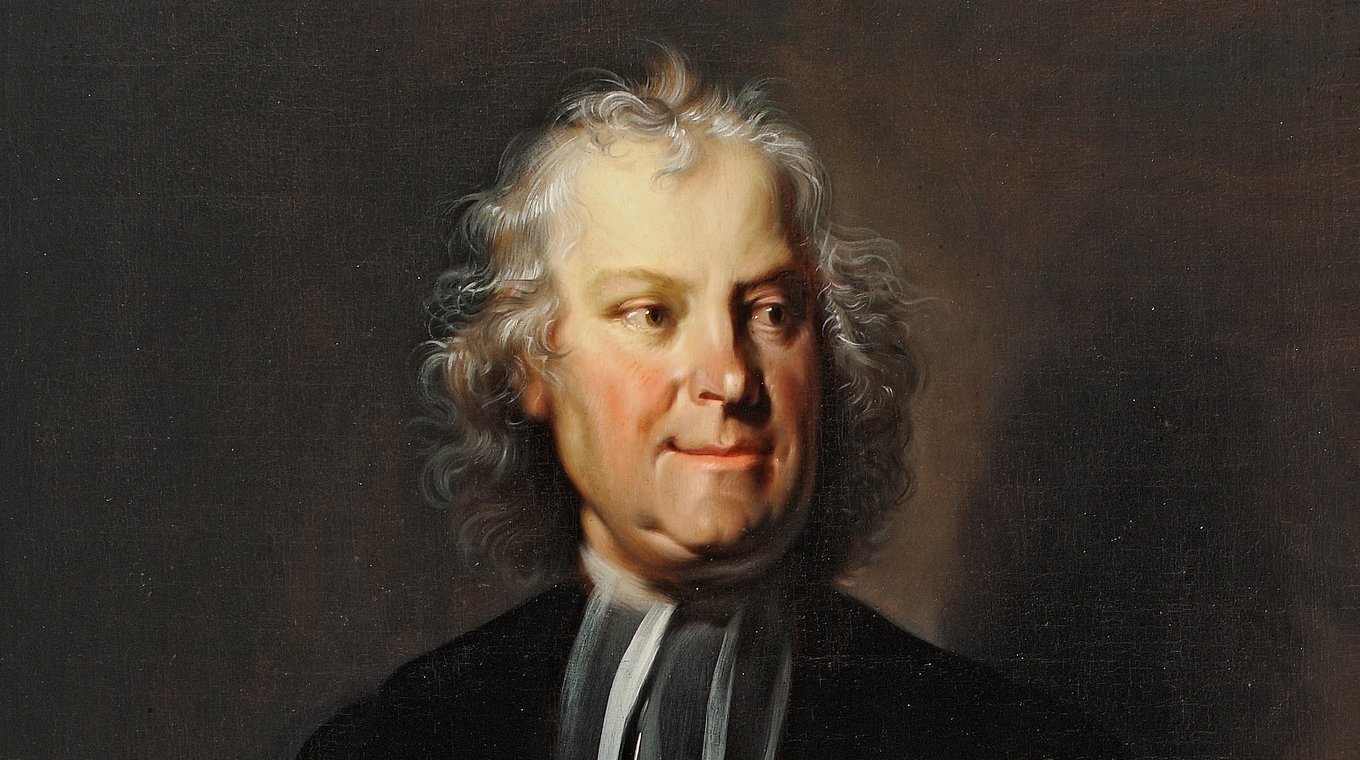
Herman Boerhaave - painted by Cornelis Troost

Boerhaave was way ahead of his time, arguing that medicine should be based not only on a theoretical study of the human body, as had been standard practice until then, but on close bedside observation of symptoms. At the St Caecilia Gasthuis municipal hospital in Leiden he maintained a 12-bed ‘teaching ward’ where students followed each patient’s treatment and drug regime as a ‘case study’ – just as Alice Edith Vlieland saw puerpural fever being passed from nurse to new mother in the lying-in wards of Heavitree and pioneered a hygiene regime to combat it.

Dr Michael Lee Dicker studied with Boerhaave for a year in 1717–1718, gaining his Doctorate in Medicine from Leiden University before setting up in practice in Exeter and ten years later commissioning Magdalen House in Magdalen Street. When the Royal Devon and Exeter Hospital was opened in 1743, he was among some of ‘the most distinguished doctors and physicians in the country’ working there, including Thomas Glass (1709–1786) and John Andrew (?1700–1772), both Boerhaave pupils.
Thanks to Barbara

European Museum of the year Rijksmuseum Boerhaave Leiden .

Our museum has been named after Herman Boerhaave (1668-1738), one of the leading scientists in Europe in his day. He was an allrounder: a skilled physician, anatomist, botanist, chemist, humanist and researcher. He had a great reputation as a teacher at the University of Leiden and for a long time held three of the five chairs in its Faculty of Medicine. He was also Rector of the University of Leiden and Director of the Hortus botanicus.

Wednesday, 26 February 2020

S.S. Mendi rememberance

This week on February 21 in Noordwijk Holland the remembrance of the S.S.Mendi took place .


In the annals of South Africa’s military history, 21 February 1917 is a dark day. It marks the sinking of the troopship SS Mendi after it was rammed off the Isle of Wight, with the loss of 616 South African servicemen, 607 of them members of the South African Native Labour Corps: Zulu, Xhosa, Sotho, Swazi, Tswana; the names on the SS Mendi Roll of Honour reflect every corner of Southern African society, then or since.

Today, the anniversary of the SS Mendi disaster is aptly the day on which South Africa remembers her fallen soldiers. Across the country, parades and ceremonies will be held to commemorate those South Africans who paid the ultimate price in wars across the globe.

Only a fraction of the bodies of the SS Mendi casualties were ever found. Of those, 13 lie in the UK. One, Private Beleza Myengwa, was originally buried near Le Havre in France, but in July 2014, was ceremoniously re-interred at the South African National War Memorial at Delville Wood, in the presence of South African Deputy President Cyril Ramaphosa.

He was carried to his grave by serving South African soldiers, sailors, medics and airmen, past an honour guard of South African and French military veterans.

But another five SS Mendi casualties, Private A. Leboche, Private Arosi Zendile, Private Sitebe Molide, Private Natal Kazimula and Private Sikaniso Mtolo, lie in the Commonwealth War Graves Commission section of the General Cemetery of Noordwijk, just north of The Hague in the Netherlands.
Though neutral during the First World War, the Netherlands was not spared from hosting the casualties of a war that was fought within earshot.

It is our fervent hope that you (or your representative) will be able to join us in this unique tribute.


The sinking of the SS Mendi was one of South Africa's worst tragedies of the First World War, second perhaps only to the Battle of Delville Wood (Image: South African Navy)One of South Africa's worst military disasters is to be taught in British schools to highlight the role of black soldiers in World War I, the Commonwealth War Graves Commission announced on Monday.

A total of 616 South Africans, including 607 black troops serving in the South African Native Labour Contingent, died when the steamship SS Mendi sank in the English Channel on the way to France on 21 February 1917.


More about the s.s. Mendi 

remembrance in Cape town 2020

A service has also taken place at Milton Cemetery in Portsmouth to remember the South African troops who lost their lives in the sinking of SS Mendi in February 1917.

And also on Armed Forces Day | Commemorating 1917 sinking of SS Mendi: Simphiwe Dlamini


There was a play about the s.s. Mendi.


Most had never seen the sea, many couldn’t swim, few returned.

January 1917, 823 South African men board the SS Mendi in Cape Town, volunteers for the British Army bound for the Western Front.

Heavy pre-dawn fog shrouds the impending disaster. The collision comes with such force that the SS Mendi sinks in minutes. By the time rescue arrives, it is too late for most.

Dubbed the ‘Black Titanic’, the sinking of SS Mendi was one of the worst maritime disasters in the 20th Century in Southampton waters. Yet, a startling story of hope and courage emerges. Brought to life with live music by the critically acclaimed Cape Town based Isango Ensemble and part of 14-18 NOW, the UK’s Arts Programme for the First World War Centenary.

SS Mendi is a powerful and moving celebration of life at the moment of death. A group of men who start out on their journey as individuals, small groups from different tribes, with conflicting cultures and worldviews, become united into a group of brothers who dance the death drill as the boat goes down
“Poignantly beautiful”

The Guardian
★★★★★

“Knocks the breath from your body”

The Times
★★★★★
"Like nothing I have seen before”

Broadway World
★★★★
“a powerful emotional story… a show and a story that deserves greater exposure”
Pocket Sized Theatre
★★★★
“An otherworldly requiem”

The Stage

Monday, 24 February 2020

George Edward Arnold

Cornelis Pieter Vlieland married Elizabeth Maria Arnold.
Her father is John Samuel Arnold 
His father is George Edward Arnold .
The names sound very British so we looked for the father of George Edward Arnold.
And they are very Dutch,so no English roots.
Vader/father 
Willem Johannes Arnold ijzergieter
Moeder/mother
Fijtje Heijn
Kind/child  George Edward Arnold, geboren op 22 januari 1863 te Delft


Saturday, 22 February 2020

ice carnival bazaar


CHURCH EXTENSION EXETER. ICE CARNIVAL BAZAAR. THE OPENING CEREMONY. Yesterday afternoon saw the inauguration of lee Carnival Bazaar at the Victoria Hall, Exeter, which has for its'object the raising of money towards a fund for church extension in Exeter, and especially for the building of now church for the Emmanuel district of St. Thomas. The scheme has been eagerly taken up, and although so large sum as £7,000 is needed to carry out the contemplated work, the energy with which the task has been undertaken is so marked—and all classes of people are co-operating—that success is assured. A favourite manner of raising money for chantable and other objects is by means of bazaar. They take variety of forms, and an Ice Carnival is novelty in Exeter. The Lord Bishop the Diocese lent his patronage to the movement, while General Sir Redvers Buller, V.C., X.C.8., was appointed President. The Vice-Presidants included the Mayor Exeter and the Sheriff, and there strong list of patronesses. The Entertainment Committee has Mr. R. A. Kay for Chairman, and Gidley is Vice-Chairman. The Executive Committee consists of Messrs. J. Gould, G. F. Gratwicke, W. Mumford, A. Snow, the Rev. E. Peacock, and the Rev. C. H. Williams. Mr. T. Snow, of the City Bank, Exeter, is the Hon. Treasurer, and the Hon. Secretaries include Mr. J. Gould, the Rev. E. Peacock, Mr. F. Sercombe, and Mrs. C. H. Williams. All these laboured most energetically, Mrs. Williams working particularly hard to further tho success of the Bazaar. The opening ceremony took place at 2 o'clock. The Right Worshipful the Mayor (Mr. Alfred S. Perkins), accompanied by the Sheriff (Mr. C. R. M. Clapp), the Mayor's Chaplain (the Rev. S. W. E. Bird), the Sheriff's Chaplain (the Rev. E. T. Foweraker), Mr. G. R. Shorto (Town Clerk), and Councillors Hutchings, Varwell, Yeo, Surridge, and Gidley, met the Guildhall, and, accompanied by the mace-bearers and a posse of police, in charge of Chief-Constable- Short, proceeded in State to the Victoria Hall. The Civic party was met the entrance by the officebearers, the stall-holders and their assistants, dressed in a variety pretty costumes. arriving in the large Hall the Mayoral party ascended the platform, upon which were the Dean of Exeter and Miss Cowie, the Mayoress (Miss Perkins), Mrs. Clapp, the Archdeacon Exeter, Mr. Snow, Mr. T. Snow, the Rev. Canon Trefusis, the Rev. Canon Edmonds, Sir George and Lady Williams, Right Hon. and Rev. the Earl of Devon, the Revs. H. Bickersteth, C. F. Williams, J. .M -rgan, E. Sparshatt, C. J. Valpy French, E. Peacock, General Sibthorpe, the ex-Mayor (Mr. E. J. Domville), Mr. Councillor Wreford, Messrs. C. E. A. Brash, C. J. Vlielaud, Sebastian Snow, Langdon Thomas, E. H. Shorto, and others. As the party took their seats on the platform Mr. D. Wood, the Cathedral organist, played the National Anthem. Special prayers been offered by the Rev. C. F. Williams, The Dean of Exeter said they had met that day to open a Bazaar which had for its object the raising of considerable sum of money towards the erection of new church for the Emmanuel district of St. Thomas. Although he did not care much about this manner of aiding charities, yet, in obedience to the made upon him, he felt it his duty to exhort them, far as they could, do their best to make this undertaking success. The object the Bazaar, of course, must always kept in view. He would impress upon them the great blessing which must accrue if this work was successful. In tho Emmanuel district they had large population, and many of them were very anxious have church there, and they themselves had shown this by the liberal and laborious efforts they had made to promote, the success of this good work. That especially was applicable to the working-men of the parish, and he was told there was a si>ong feeling among them to do all they possibly could to attain the great object in view. Ho need net enlarge upon the advantages of having church among labouring population. If any them felt weary of the work they had undertak that day they could refresh themselves the thought of others who had made considerable sacrifice for this work. The great blessing of having church in the midst of vast population was tha* the people had the means of grace brought home to them. A place for meeting for prayer and instruction in the Gospel was necessary thing. They must remember they were working for the spiritual good their fellow-men, and that should encourage them to go on with the work. now had pleasure, on behalf of the Church Extension Committee, in asking the Mayor to declare the bazaar open. (Applause.) The Mayor of Exeter said it had given him a great deal of pleasure to come there for re reasons than one. He was very closely connected with the earliest part of this movement in the higher part of the town. (Applause.) Churchwarden for some years of St. Sidwell's was intimately associated with the building of St Matthew's. The lower part of the town no*- called upon them to assist thorn, and he did not think any would refuse listen to that call. He was certain from the large number assistants, the beautiful arrangements «*hich had been made, and the way in which tho hall had been decorated, there would energy wanting on the part of the ladies and gentlemen to make the bazaar thorough success. (Appause.) declare! the bazaar open, and hoped the result would accord with the utmost of their »visaes. (Applause.) Mr. Snow proposed vote of thanks the Dean for presiding and to the Mayor for bis attendance. They appreciated the kindness the Dean in being present in spite of his health, and enc uraged them to see ono so high th: Church of that city take interest in the rtaking. For some time past they had md the support not only of the Cathedral clergy, but the parochial clergy of Exeter. They could tjOl be too thankful for that. They were much obliged the Mayor for attending State open the bazaar. (Applause.) Sixteen years had passed since they were promised that St. Thomas .should the next parish attended hy the Church Extension Committee. He thanked God he had lived loug enough to see the success of the scheme. During all their meet ings the Mayor had given his kindly support, notwithstanding the duties of office had greatly increased what they were 30 years ago. When they considered how the Mayor's * was taken up the first citizen of Exeter they could scarcely sufficiently thank him for his attendance that day. (Applause.) Sir George Williams seconded. The young people, he thought, would never forget what they saw on that occasion. was stated that the labouring-class numbered five to one of the upper class, and that they would be the governing power by-and-tye. that was so, they should trained, educated, and especially provided with means of grace. (Applause.) If the mountain would r.ot to Mahomet, Mahomet must go to the mountain, and the Gospel end glad tidings of great joy must be carried to the labouring-classes. Lady Williams and himself had "aken a great pleasure in coming to Exeter on purpose' to be with them that day. (Applause.) He was pleased to see how their dear son was working, and he was delighted seeing the Dean among them. (Applause.) General Sibthorpe supported the votes of thanks. He had heard people say they would be glad to assist if the church was being built in their own parish. St. Thomas had the peculiarity of belonging to all tho parishes of Exeter, because was the home of all the people who were working for them in the city. They went to all parishes work, and returned to their homes in St. Thomas. He rejoiced to find ihe whole of Exeter was nobly taking up the work. That bazaar was only the commencement of the interest they would ultimately take, and he trusted that far and wide many would be found ready to come forward with plenty of money, that the proposed new church might be quickly erected. Tho motion having been carried by acclammation The Dean replied, and was followed by the Mayor, who remarked that one speaker said St. Thomas belonged to Exeter. They were only too she ihould. (Laughter.) She was a little coy present. However, in »his matter, he hoped Exeter would belong to St. Thomas and St Thomas would belong to Exeter. (Applause.) At the conclusion of the speeches, Master Jack Brash, dressed page, led Miss Ivy Buckingham, attired to represent " Forget-me-not," on to the platform, and the little lady graciously handed bouquet to the Mayoress. Master C. Gould, in a XV. Century Court dress, theu escorted Miss Fanny Vlieland, dressed as a dancing girl, and she handed a bouquet to Mrs. Clapp, the wife of the Sheriff. The opening ceremony then concluded, and business commenced. Prior to ,'nspecting the various stalls, the following telegram was handed to the Mayor, it having been sent by the Committee over the electric wire fitted up in the Hall: —" We congratulate and thank the Mayor and Mayoress for their kind presence in opening this bazaar. May the magnetic influence pervading this Exhibition potent to attract funds toward the object in view." Tho scene the commencement of business was a most picturesque one. The ladies in charge the various stalls wore dresses illustrative of the country the stall represented. The "old woman who lived in shoe" (Miss Dorothy Vlieland) was drawn round the Bazaar by a number of children attired in handsome costumes, and she was attended by a bevy of little girls carrying gaily-decorated arch ribbons and flowers. A TOUR OE THE STALLS. The Victoria Hall presented a most attractive and novel appearance. The stalls, arranged round the room, were representative of dwellings covered with frost and snow. Taking view of the Hall from near the organ, a sketch of which is reproduced here, Lady Poltitnore's flower stall stands prominently tho centre. is covered with the most handsome blooms, and with her ladyship are the Ladies Northcote, Mrs. llodgkin, Miss Collins, Miss I. Snow, Mr. Charles Sheridan, Mrs. Gibbons, and Miss do Sales La Terriere. Behind it the old-fashioned village well, from which many articles, both useful and ornamental, can drawn upon payment small fee Mrs. Lucas or the Misses Lucas. In close proximity is " Montreal," the refreshment stall, with Mrs. Byrom, Airs. Johnson, Misses Grace Burrowes, J. Byrom, S. Dv Cane, Fox, Hilda Grimston, Howard, Mildred Savile, and Strong in charge. Here the most toothsome delicacies are obtainable, while the ice caves form delightful retreats in which to partake either light, luncheons or afternoon teas; and the pleasure enhanced by the charming manner of the fair vendors. the right is Germany," with Mrs. Gratwicke the head of affairs, and this lady has taken a very active part in the promotion of the Bazaar. She has with her the Misses Beal, Cater, Gould, M. Gratwicke, Manley, and Satclcll, the Masters Gratwicke, Messrs. George Beal, A. Cater, E. W. Oliver, J. Orchard, W. Paekham, H. Powell, L. Pollard, Saunders, Turner, and C. Gould. In the stall is large variety fancy and useful clothing for children, very handsome sofa cushion squares in Indian muslin, dolls, Macrame work, and numberless other items. painting of St. Michael's Mount, Mr. A. Uren, of St. Thomas, was also prominent feature. The contributors the stall included, among many others, Lady Kennaway, Lady Poltimore, Mrs West, Miss Quick, Miss Cater, Mrs. Beal, Mrs. Gould, Mrs. Peacock, and Mrs. Parnell. Lady Williams, Miss Tripp, Mrs. Swabey, the Misses Bazeley, Biggs, K. Biggs, L. Bowles, L. Gossett, B. Perring, and E. L. Perring, attired in Swiss dresses, are energetic in relieving " Switzerland" of tho number of articles which burden it. There here fine collection of antique Japanese embroidery and interesting novelties in the shape of Japanese kites. Miss Harvey, of the Cathedral-yard, contributed some capital lace work. The other things worthy of attention are novel fire screens, sofa cushions, and carved wood box. At " Normandy " Mrs. Snow, Mrs. S. Snow, the Misses Bickersteth, E. Biddell, M. Biddell, K. Bond, Granger, E. Granger, Merivale, Savile, Swabey, Trevitkick, M. Trevithick, and Mrs. Batson are most enthusiastic in praise of the excellent workmanship the heaps useful clothing displayed by them. The Emmanuel district children's and men's working parties have shown practical sympathy with the work in hand loading tic England " stall nearly broking point with enormous supply of attractive brackets all shapes, and carved in all conceivable designs. Texts have been framed, fancy tables made, and' here articles too numerous to detail can be purchased from Mrs. Pearse, Miss Green, Messrs. E.. C. Lea, H. Pearsc, and C. Stokes, Mrs. Bowyer, Mrs. Coombes, Mrs. Lea, the Misses K. Bowyer, and F. Coombes, Masters Frank Lea, W. Penton, and W. F. Stokes. Next to " England is parcels delivery office, superintended by Mrs. Colson, Mrs. Bromley, Mrs. Grayson-Smith, Mrs. Wynter, the Misses Colson, Grayson-Smith, M. Grayson-Smith, Hewlett, Wynter, and Sproule. The organ hidden by Alpine scenery. In front of the platform Blundeil's stall, presided over' by Mrs. Francis, Mrs. Booper, Mrs. Spring, Miss Norman, Mrs. W. Riddell, Miss Lindsey, the Misses R. Chapman, C. Francis, Lyon, Pittar, and Tripp. Here fancy articles are displayed in so tempting manner as to attract a large share of patronage; while the hesitating are soon induced to add to the coffer by the winning ways of the ladies, who look charming, wearing the colours of this famous school. Near here is prize winner yacht, given Mr. Sparshatt for the benefit oi» the Bazaar fund. The electric grotto is in close proximity. " Norway is the next stall. The Emmanuel parish working party have filled it with useful and fancy work, Mrs. C. Stokes, Miss Berrie, Miss Cox, Miss M. Quick, Mrs. Beacham, Mrs. White, the Misses J. Berrie, Bovey, Campfield, Dark, Thomas, and Warmington, and Mis. Newson being in charge. Below we give a representation of Russia " the stall presided over the Countess of Devon, assisted by Lady Courtenay, Mrs. Edmonds, Mrs Cobham, Mrs. C. H. Wililams, the Misses Courtenay, and A. and W. Edmonds. On the stall were displayed a number of pictures, fans, inkstands, stationery and fancy goods. An attractive feature here was a model May-pole, with all the accessories, forming a most pleasing plaything for children. At " Iceland " visitors are tempted purchase Breton pottery, Faenza ware, besides a choice collection of Worcester china, presented by Mrs. Grant. The ladies who energetically disposed these articles were Miss Williams, Mrs. Kindersley, Mrs. Brandt, Miss Kindersley, the Misses Arundell, Brandt, K. Brandt, Domville, Kennaway, E. Kennaway, E. A. Kindersley, M. A. Kindersley, and Woollcomhe, and Master D. Domville. At " Canada" could be secured men's outr fitting, soap and perfumery, pen-wipers, pincushions, and such like. The manner in which the unwary were tempted to buy was most entertaining, the following ladies being most successful saleswomen : Miss Montgomery, Mrs. Cragie- Halkett, Mrs Longdon, the Misses Cragie-Halkett, Constance Cowie, Smyth, Townsend, A. Town- send, Vyvyan, Mrs. A. H. Williams, Mrs. A. T. Williams, Mrs. F. G. Williams, the Misses Amery, G. Amery, and French. THE DOLL SHOW formed an immense attraction. The Mayoress, Mrs. C. R. M. Clapp, Mrs. A. Buckingham, Mrs. Kay, Mrs. Shrove, Mrs. T. Snow, Mrs C. J. Vlieland, the Misses Brash, F. Buckingham, Eames, M. Perkins, Vlieland, D. Vlieland, P. Vlieland, and Masters Vlieland and Brash, and Miss Ivy Buckingham were in charge, and sold dolls of all kinds. There were dolls of every conceivable expression, fair dolls, dark dolls, and others decidedly auburn. Some dolls reclined in hammocks, others were accompanied by their brothers, rheir sisters, and their aunts. Red Riding Hood md 80-Peep were present with foresters, sailors, brides, huntsmen, Spanish ladies—in fact, every nationality was represented, and every style dress was carefully reproduced. Prizes were offered in various classes. Class I. was for baby dolls, and Miss Dart secured the first prize, given by Miss Williamson, of a silver buckle and painted plaque, for beautifully dressed doll. Mrs. Shrove's second prize of a Prayer-book in case, was taken by Mrs. Simpson. In Class 11. the first prize doll was an Italian gipsy, dressed by Mrs. Brash, that lady winning a clock given by Mrs. Vlieland. The second prize, calendar and clock, was secured by Miss Clarke. Class 111. brought together 36 dolls. The first prize, opera glasses, given Mrs. Francis, was taken Mrs. S. Pope, who exhibited a handsomely-dressed bride, with veil and wreath of orange blossom, and carrying shower bouquet. The second prize—a clock given by Mrs. Gratwicke—was won hy Miss Wood. The first prize in Class IV.— small dolls for dolls houses—a dinner gong, given by Mrs. A. Buckingham, was secured by Miss D. Vlieland, and Mrs. Buckingham was second, taking a picture, In Normandy," given by Miss Kindersley. In the competition for children under 16 years, the first prize, writing case, given by Mrs. Edmonds, was taken by Miss Norman, aged 6 years, and Miss D. Vlieland, aged years, was second, securing present scent l>ottles. Class VI. was open to children under 16, and the Mayoress's prize of silver-mounted hand glass was won by Miss Hailes, Miss Muirhead, of School House, Otterton, being second, and securing Mrs. Cecil Clapp's prize—a travelling clock. The Countess of Devon has given tray, carved by the inmates of tho Western Counties' Idiot Asylum, Starcross, for the best doll in the Show, and the result depends on the votes of those visiting the Show. Altogether, there were 76 dolls entered for competition. The Electrical Exhibition was largely patronised, I the illuminated grotto under the organ gallery being" a distinct feature. Mr. J. W. Lusty, Assistant-Telegraph Superintendent the Exeter Post-office, was in charge of number of telegraph instruments, the workings of which were explained. There were also shown several models, constructed by Mr. G. Turner, of the Royal Engineer Telegraph Staff, Exeter. They included an electric tramway and motor car, a small dynamo, and several other interesting works. The floral design suspended over the tabling has charming effect when illuminated. Mr. S. Mundell, of 38, West Southernhay, has lent the necessary storage batteries or accumulators for the running of the models and the illumination the lamps. The large hall and the Doll Show are lighted by electricity the Exeter Electric Light Company. Character reading took place in the electric grotto by Miss Murphy. Mr. Crompton was in charge of the shooting saloon. A series of excellent entertainments took place, Mr. Kay working this department with much energy. There were marionette exhibitions, lectures of an amusing nature, and concerts. The numerous visitors found plenty of means of amusing themselves, as well as benefiting the funds. When the Hall was lighted the effect was more striking, the quaint buildings in their wintry aspect being especially attractive. The result of the day's sales was as follows : s. d. Montreal (Mrs. Byrom) 10 14 11 Russia (Countess of Devon) 10 3 3 Canada (Miss Montgomery) 11 3 Ireland (Miss Williams) 15 0 0 Norway (Mrs. Stokes) 8 17 Germany (Mrs. Gratwicke) 11 6 7 Switzerland (Lady Williams) 11 4 6 Normandy (Mrs. Snow) 18 14 10 England (Mrs. Pearse) 6 10 9 Bran Well (Mrs. Lucas) 2 2 0 Flower Stall (Lady Poltimore) 5 12 3 Blundell's (Mrs. Francis) 23 0 0 Dolls (the Mayoress) 13 9 Parcels (Mrs. Colson) 0 14 9 Sundries 4 0 Admissions 16 8 0 Entertainments 9 17 178 14 1 The ice nsed for the carnival is being presented each day in two hundredweight blocks Messrs. Mock and Son, Martin's Lane, Exeter. The pianoforte is lent for the week by Mr. J. C. Guest, who has also presented the programmes used for the concerts. The Carnival will he opened to-day at o'clock MAYORAL CHAIN FOR DARTMOUTH. Dartmouth is an ancient borough, and nothing, perhaps, affords the inhabitants greater pleasure than revealing to others the events of different epochs in their history. Yesterday was an occasion when the Mayor, members the Corporation, and burgesses revelled in this interesting occupation, and whatever might have been thought before, those who attended the ceremony the presentation of a Mayor's chain left convinced that the picturesque town situated the mouth of the English Rhine not of mushroom grow th. They were told with much emphasis that "when the River Clyde, was mere gutter, and Liverpool mud bank, Dartmouth was well-known Southern port." But, notwithstanding their ancient Charters, interesting history, and long list Mayors, the town has hitherto lacked a chain office for the Mayor. Yesterday this deficiency was made up by the presentation to tho Corporation of a chain, towards which many interested in the prosperity of the town have subscribed, worthy to adorn the scarlet robe of the Chief Magistrate. The chain, which is of solid gold, and weighs rather more than ?Alh., is fine specimen the goldsmith's and engraver's art. It consists of 23 links and 16 shields. Ten of the latter are the outer festoon, and six in the inner. The arms of the various monarchs who have granted Charters and concessions to the borough, the representat;ons of the Dartmouth and Kingswear Castles, of tl»e harbour, the lighthouse and beacon Kingsu ar, the ships crescent and Hart, the Britannia, the sailing of the ships Speedwell and Mayflower, the chain which in past days was placed across the mouth of the harbour, the numerous seals which have been in local use, the arms of Flavel, Hawley, and Newcombe, together with those the Scale, Seale-Hayne, Prideaux, Hunt, Bridson, Brooking, and Orme-Webb families, the d>-vice the. Naval bank, the names and dates of many Mayors, a.s well as those the first M.P.'s of the borough and Hbldsworth Governors of the past, and many other local records figure upon the shields, which are surmounted by galleys illustrative of the device known as the special emblem upon the Dartmouth seals and arms. They ar,; connected witli each other by letters C. D. 11., the initials of the full title of the borough—" Clifton Dartmouth Hardness." The donors links are follows:—The Rev. W. F. Newman (Hockworthy), Sir H. P. Scale, Bart., the Right Hon. C. SeaJe-Hayne, M.P., Mr. A. H. HokLsworth, Mr. H. M. Turner, Mr. W. Smith (ex-Mayor), Mr. R. Cranford, Mr. R. W. Prideaux, Mr. Arthur Arnold (Chairman of the London County Council), Mr. G. H. Collins, Mr. Roope Brooking, Mr. J. L. Teague, Mr. T. Bulteel, Captain Orme-Webb, R.N", (the present Mayor), Mr. A. H. Bridson, Mr. A. R. Hunt, and Dartmouth Harbour Commissioners. The Council, burgesses, and others " have given a handsome oval pendant, which contains the arms of the Queen, Richard I. (on account of the Crusaders sailing from Dartmouth), Henry VII. (building of the Castle), and James I. (Charter of Incorporation). It also gives the dates the several Charters, and particulars of many notable events in the history of the ancient borough, recording the fact that the first members of Parliament were Johannes de Bakere and Willielmus Alte Vosse, 1296. It cost £234 5s *id. The Mayor (Captain Orme-Webb) and Mayoress with the guests of the day, arrived shortly after 1 o'clock at the Guildhall, the interior which was fitted large number of ladies and gentlemen, including members of the Corporation. The assembly was not without brilliancy, for on the bench beneath the large portraits of past Chief Magistrates of the borough sat, in addition to the Mayor of Dartmouth, their Worships of Totnes, Plymouth, Falmouth, and Torquay, adorned in their robes and chains of office; Commander Castiglia, of the Italian Royal yacht Savoia; Sir If. P. Scale, Bart,, who has been 16 times Mayor of Dartmouth; the Right Hon. C. Seale-Hayne, M.P., and the of the London County Council (Mr. Arthur Arnold). In front of the bench v.ere the two Maces, and beneath, on a table, was placed the chain, which, of course, was viewed with considerable interest by those present. The Mayor of Dartmouth was loudly applauded on rising. He remarked that they might safely assume that never had such representative assembly gathered within the walls the Guildhall. They were met for an important event, and they had honed have seen, in addition to those present, the Lord-Lieutenant of the. County (Lord Clinton), the Sheriff of Devon (Sir John Shelley). Mr. Mallock, M.P., and Mrs. Mallock, the Mayor and Mayoress of Exeter, the Mayor and Mayoress of Devonport, Mr. and Mrs. Simpson, and several ot hers, but they were unable to attend. was glad welcome those present, more especially the representative of friendly Power. Concluding, paid iribute to the work of the. ex-Mayor, and said that hail it not been for his exertions there would have been no presentation a chain that day. (Applause.) The presentation of the chain was made by Sir Henry Scale. banquet, which was numerously attended, was subsequently held at the Subscription Rooms. ST. THOMAS STONE-THROWING NUISANCE. Yesterday, at the Castle of Exeter, Albert Charles Salter, Riohard Martin, and Frederick Tarr, boys, St. Thomas, were sommoned for damaging the property of the St. Thomas School Board May 8. P.C. proved seeing the boys throwing stones the Okehampton-road School, a portion of a terra cotta ornament being knocked off. Mr. Champion, Clerk the School Board, said the cautions which the Ben?h had given in previous cases did not appear have had any substantial effect preventing the s*onethrowing nuisance. Martin was one of five lads who were summoned few weeks ago for breaking into the school premises and stealing property. The damage iv this case was ss. Salter and Tarr were fined 3s each and Martin 5s with costs.

Sunday, 16 February 2020

Anthony Wildeboer

Searching for Anthony Wildeboer it was a surprise to find this name of the manager of Plantation ala Bonheur  in Suriname  in the papers  in England .

London Gazette 8 January 1833

but then we found his death certicifate .He was the son of Anthony Wildeboer .He was widower of Eliza Judith Bayne .
Name: Anthonij Wildeboer
Event Type: Death
Event Date: 17 Jan 1852
Event Place: Amsterdam, North Holland, Netherlands
Event Place (Original): Amsterdam, Noord-Holland, Nederland
Gender: Male
Age: 57
Birth Year (Estimated): 1795
Father's Name: Anthonij Wildeboer
Spouse's Name: Eliza Judith Baijne
Spouse's Gender: Female
marriage 

Name: Anthony Wildeboer
Spouse's Name: Elizabeth Judith Bayne
Event Date: 03 Oct 1816
Event Place: Saint Dunstan,Stepney,London,England


Interesting it says in his deathcertificate ,his  parents are deceased.
His  father is also Anthony Wildeboer his mother is unknown .
So maybe she was a slave on the plantation .


arrived Texel Anthony Wildeboer from Surinam


death of the son of Anthony Wildeboer and Anne Margaretha Wildeboer -Lucassen October 6 1809
Cornelus Johannes Wildeboer at the age of 35 . 


 born daughter of the wife of Anthony Wildeboer Johanna Rincke 

arrived from Surinam in Havre de Grace 

In Surinam arrived  

death of Anthony Wildeboer aged 83 years and 11 days  January 28 1820 .Captain round the west.


Thursday, 13 February 2020

Plantation A La Bonheur Surinam

Yesterday we met Woerden Vlieland a slave who was freed before all the slaves were freed by Manumission, or affranchisement, is the act of an owner freeing his or her slaves.

We know the name of the plantation in Suriname. It was a la Bonheure  or Good Luck as it would be in English .

After it went from a coffeeplantation into an indigo plantation the name changed to Smaradoekoe which is the suriname word for indigo.

Rivier Beneden-
Commewijne, links in 't afvaren. The plantation was on the Crommewijne river on the left side  A la bonne heure. owners H.J. Franken en A. Wildeboer. manager in Suriname A. Wildeboer.


The plantation was on the Crommewijne river on the left side .
The owner was Hendrina Johanna Franke . And later A.Wildeboer .(So far nothing found on them)
Woerden is mentioned on two other plantatations 1,Runawaycamp Weglooperskamp I and
Suzanna's Daal as we can see in the last column of the slaveregister  was found on Fort New Amsterdam.


Voor verdere informatie over de personen met deze achternaam kunt u het archief Suriname en de Nederlandse Antillen: Vrijverklaarde slaven (Emancipatie 1863) raadplegen.

Wednesday, 12 February 2020

Woerden Vlieland

Looking for a new lead in the never ending search for the name Vlieland , we found an unexpected one .
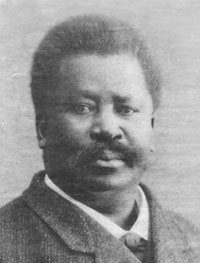
We found in a list of freed slaves of Surinam a man with the last name Vlieland and the first name Woerden . Who lived on the Plantage a la Bonheur.
So we started to find out why this man was called Vlieland and was a manumission slave.

Well what is Manumission, or affranchisement, is the act of an owner freeing his or her slaves. Different approaches developed, each specific to the time and place of a particular society. Jamaican historian Verene Shepherd states that the most widely used term is gratuitous manumission, "the conferment of freedom on the enslaved by enslavers before the end of the slave system".

The motivations for manumission were complex and varied. Firstly, it may present itself as a sentimental and benevolent gesture. One typical scenario was the freeing in the master's will of a devoted servant after long years of service. A trusted bailiff might be manumitted as a gesture of gratitude. For those working as agricultural laborers or in workshops, there was little likelihood of being so noticed.

Date manumissie of Woerden Vlieland 31-12-1846


Then we searched for the plantation
Plantages /plantation A / A-La-Bonne-Heure
(alias: Ala Bonheur)
Sranan Tongo Naam /name Smaradoekoe
Locatie/location Commewijnerivier
Grootte /size
500 akkers/fields (1819)
Producten/products
Koffie (1819); Indigo (1828)
Eigenaren /owners
1819: R. le Chevalier en P. Portielje qq.
1824: Hendrina Johanna Franke
1834: Hendrina Johanna Franke en A. Wildeboer
NB: De informatie op deze pagina is afkomstig uit vele bronnen, deze kunnen worden geraadpleegd op onze bronnen pagina.
NB: The information on this page comes from many sources, which can be consulted on our sources page.

In the census we find about the owner of the plantation nr 245 Hendrina Johanna Franke 239 278/23 Coloured

number. Head Folionumber . Inventory color
Then we try to learn more about the plantation.

A la bonne heure was a coffee plantation in the Surinamese district of Commewijne. This plantation was on the Commewijne River next to the Zoelen and Geertruidenberg plantations

This plantation, the history of which is relatively unknown, was built around 1745 by Abraham Lemmers and dissolved in 1885. The plantation was originally called Smaldoek, or in Surinam: called smaroekoekoe, a name that probably originated because of its narrower and longer shape. According to the map of Alexander de Lavaux, the wife of Charles Godefroy, from plantation Alkmaar, was the next owner.

In 1793 the wealthy Gideon Adriaan Diederik de Graaff became the owner of the plantation. He owned four plantations and was the administrator of 27 other plantations. His sister was married to Pieter van der Werff Pieterz III. The owner of the plantations "Dordrecht" and "Killenstein". De Graaff probably changed the name of the plantation to "A la bonne heure".

The plantation then became the property of the Le Chevalier and Portielje fund, which also owned the Crommelinsgift, Dordrecht, Fakkertshoop, Leliëndaal and Tourtonne plantations.

The fund in turn sold the plantation to Hendrina Johanna Francke, who turned it into an indigo plantation. This cultivation quickly disappeared due to the emergence of synthetic dyes. In 1834 there were only three plantations growing indigo in Suriname, which was probably the reason that in 1834 Francke sold half of the plantations to Anthony Wildebroer.

Gijsbert Christiaan Bosch Reitz became the next owner. He was also the owner of the Geertruidenberg and Zoelen plantations. The plantation was adapted by Reitz's son Jean Philippe in a sugar cane plantation. The sugar cane was sold to the Mariënburg central factory.

In 1882, Reitz founded, together with the banker J.G. Sillem and the management of the Nederlandse Handel-Maatschappij in Amsterdam set up the NV Landbouw Maatschappij Commewijne. In 1884, the shareholders were already faced with the choice between liquidation or capital expansion. The company then decided to take over all shares and continue the exploitation for its own account. A year later, the shareholders' meeting decided to dissolve the company

www.surinameplantages.com

Saturday, 8 February 2020

Theodorus Ferdinand Doll

Theodorus Ferdinand Doll 30 june 1803 is the brother of  Antoinetta Doll wife of Cornelis Vlieland 
They named their son after him. Theodorus Ferdinand Vlieland


And Theodorus Ferdinand Doll named his child Antonetta after his sister ,

Friday, 7 February 2020

Theodorus Ferdinand Vlieland


Father of groom Cornelis Vlieland, residing in Mandenmakersteeg, viskoper/fishmonger by profession
Mother of groom Antoinette Marie Dol, residing in Mandenmakersteeg
Groom
Theodorus Ferdinand Vlieland, born on February 28, 1825 in Leiden, 27 years old, residing in Mandenmakersteeg, viskoper/fishmonger by profession
Bride Wilhelmina van Romburgh (zich schrijvende van Romburgh), born on July 29, 1823 in Leiden, 29 years old, no profession
Father of bride Pieter van Romburgh, residing in Donkersteeg, winkelier by profession
Mother of bride Lena Frankhuyzen


Theodorus Ferdinand Doll 30 june 1803 is the brother of  Antoinetta Doll wife of Cornelis Vlieland 
They named their son after him. Theodorus Ferdinand Vlieland

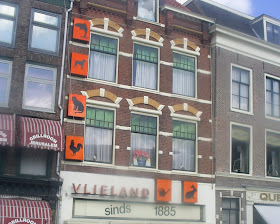
Theodorus Ferdinand Vlieland  had a shop on the fishmarket in Leiden .Which stopped recently.

Today we stop the family tree of Cornelis Pieter Vlieland.
It is already in another Dutch blog  where you can read all story's 

But one sad story we have to tell
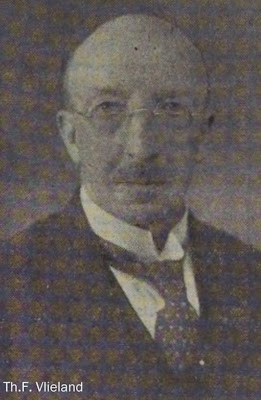
Theodorus Ferdinand Vlieland celebrates its 40th anniversary in 1933 as a seed trader in Leiden and a flower bulb grower in Oegstgeest. He has taken many initiatives during his working life to promote flower bulb culture. His death a month after the dramatic accident of his grandson Dick emphasizes the sadness about this terrible loss.
Theodorus Ferdinand Vlieland  had a shop on the fishmarket in Leiden .Which stopped recently.
The sad story is about his grandson.

Dirk Hugo Vlieland


At birth, he receives the names of his maternal grandfather: Dirk Hugo.
 A prosperous youth brings him to the boy scouts.
Hij krijgt bij zijn geboorte de namen mee van zijn grootvader van moeders kant: Dirk Hugo. Een voorspoedige jeugd brengt hem bij de padvinders.

Then THE JAMBOREE comes to the Netherlands! The scouts go on camp in 'Meyendel' in the Wassenaar dunes. That is where fate strikes: scout Dick falls from a high tree and with brain damage he is brought to the Academic Hospital in Leiden, where he dies a few days later. What a disastrous end to a wonderful camping party.

Dan komt DE JAMBOREE naar Nederland! De padvinders gaan op kamp in 'Meyendel'in de Wassenaarse duinen. Daar slaat het noodlot toe: padvinder Dick valt uit een hoge boom en met hersenletsel wordt hij naar het Academisch Ziekenhuis Leiden gebracht, waar hij enige dagen later komt te overlijden. Wat een rampzalig einde van een prachtig kampeerfeest.