Sunday, 24 May 2020

Benjamin Leigh Smith

Benjamin Leigh Smith was the father of the Leigh Smith girls .
There is a very nice blog by his grandson
At the time he lived at Hastings and also was an explorer in the arctic.
The three Samworth girls and the three Leigh Smith girls enjoyed painting expeditions around Hastings. Barbara studied art at Bedford Square Ladies College (London) during 1849 and gained some reknown as a painter. Some of her work is held at Hastings Museum; other paintings are at Girton College, Cambridge. The Hastings & St Leonards Observer wrote (in 1891) of her paintings:
The Samworth girls ,(we know Frances Samworth married Jerome Nicholas Vlieland) and  the Leigh Smith girls were also traveling to Europe together.

Benjamin Leigh Smith was born in Whatlington, Sussex, the extramarital child of Anne Longden, a milliner from Alfreton, and the Whig politician Benjamin Smith (1783–1860), the only son of William Smith, a Radical abolitionist.

On a visit to his sister in Derbyshire in 1826, Benjamin senior met Anne Longden. She became pregnant by him and he took her to a rented lodge at Whatlington, a small village near Battle, East Sussex. There she lived as "Mrs Leigh", the surname of his relations on the nearby Isle of Wight. The birth of their first child, Barbara Leigh Smith,(married name Barbara Bodichon) created a scandal because the couple did not marry, and within eight weeks Anne was pregnant again. When their son Benjamin was born, the four of them went to America for two years, during which time another child was conceived.

After their return to Sussex, they lived openly together at Brown's and had two more children. Subsequently Anne became ill with tuberculosis and died in Ryde, Isle of Wight, in 1834. Ben was only five years old.

Between 1871 and 1882, Leigh Smith undertook five major scientific expeditions to Svalbard and Franz Josef Land. He brought back specimens for the British Museum and Royal Botanic Gardens, as well as live polar bears for the London Zoo. By his fourth expedition, Leigh Smith's enthusiasm for Arctic exploration had advanced to the point that he had his own vessel—Eira—specially built.


Eira

The foundering of the Eira in 1881

Eira was built at the Scottish shipyard of Stephen & Forbes at Peterhead as a three-masted, steam-equipped screw barquentine from 1879 to 1880. John and David Gray pioneered steam engine ships and the Eira was designed along the lines of the whaler Hope and Windward. At 125 feet (38 m) long and 360 tons the Eira was seven feet longer and forty tons heavier that the Windward—built in 1866 with a 30 hp steam engine—but an otherwise close copy. The ships hull was three feet thick and the bow had a thickness of eight feet. After launching the Eira was towed to Aberdeen where a 50 hp steam engine was installed.
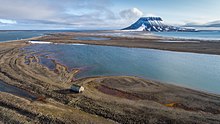
Eira Lodge on Bell Island

On 19 June 1880, the ship left Aberdeen with Captain William Lofley, captain of the Hull, as ice master, two mates, two engineers, and 17 men. On 20 June, four Shetlanders were picked up at Lerwick for the voyage and exploration of Svalbard. On 11 July, John Gray's Hope and David Gray's Eclipse met up with the Eira and Leigh Smith. Photographer William John Alexander Grant took a photograph aboard the Eira that included Arthur Conan Doyle along with Leigh Smith, the Gray brothers, and ships surgeon William Neale.

This was the exploration of Franz Josef Land, that on 18 August, resulted in the naming of Cape Flora, Bell Island, Nightingale Sound, Gratton ("Uncle Joe") Island, and Mabel Island. 
Leigh Smith discovered and named Brochøya, Foynøya, and 31 other points in northeast Svalbard. In 1881, he and his crew survived for 10 months in Russian Franz Josef Land after their ship was crushed in the ice at Cape Flora, Northbrook Island.

In August 2017, the ship was found by the crew of the research vessel Alter Ego during the "Open Ocean: Arctic Archipelagos 2017" expedition using sonar at a depth of about 20 metres (70 ft), off Northbrook Island.

Despite his expertise in the Arctic, Leigh Smith's work has received little attention, although he received the Royal Geographical Society's Patron's Medal in 1881.

Ostrov Li-Smita (Leigh-Smith Island), lying east of Hooker Island (Franz Josef Land), is named after Leigh Smith, as are the glacier Leighbreen and Kapp (Cape) Leigh Smith on Nordaustlandet, Svalbard,

Wednesday, 20 May 2020

If the mountain will not come to Mohammed, Mohammed will go to the mountain.

Every year we try and make a cruise ,
This year because of Ilness and corona it was not possible.
And then you go to the beach and what do you see .
Something never happened before and we hope will never happen again.
Cruiseships on our horizon.


There are at the moment still 120 cruiseships anchored all over the world ,for the coast of Australia,Holland,Coco Cay.
The crew is not allowed, or cannot go home because there are no flights home or they are not allowed in ports or countries.
So there are 120.000 people stuck on these ships.
Some company's bring their crew back with those ships.

But for now we enjoy the sight of those ships and maybe they sent a tender to pick us up.
We thank the crew for the happy times they gave us and hope we will meet again,don't know where and don't know when.

Saturday, 9 May 2020

John Parker

John Parker(jr) was the son of  John Parker and Mary and born on 07/04/1833 in Burgh St Peter Norfolk.
He married Maria Heath Vlieland
We know a lot about their children , but we like to know more about his father  go back in time to his father John Parker(sr)  and his wife Mary and the census of 1851.
HouseholdRoleSexAgeBirthplace
John ParkerHeadM50Blundeston, Suffolk miller windmill hill
Mary ParkerWifeF43Poringland, Norfolk
John ParkerSonM18Burgh St Peter, Norfolk
George ParkerSonM16Burgh St Peter, Norfolk
Mary Ann ParkerDaughterF10Poringland, Norfolk
William Arthur ParkerSonM8Poringland, Norfolk
Susan ParkerSonF4Poringland, Norfolk
Martha MinnsServantF20Rockland, Norfolk

census 1861 
Household
Role
Sex
Age
Birthplace
John Parker
Head
Male
60
Blundeston, Suffolk miller and farmer 
Son
Male
28
Burgh St Peter, Norfolk cord and leed merchant 
Daughter
Female
20
Son
Male
18
Poringland, Norfolk
Daughter
Female
14
Poringland, Norfolk
Nephew
Male
5
Servant
Female
17
Surlingham, Norfolk

census 1871
John Parker Head Male 70
Blundeston, Suffolk widowed farmer 39 acres employs 3 men
Susan Parker Daughter Female 24 Poringland, Norfolk
Julia M Parker Niece Female 17 Bixley, Norfolk
John H Parker Nephew Male 15 Bixley, Norfolk
Elizabeth Wymer Servant Female 19Wicklewood, Norfolk

John Parker was a miller,farmer and a wherrymen as we see in the census and birthcertificates .
He was born in 1801 in Blundeston.

Saturday, 2 May 2020

Edith Maria Parker

Name: Edith Mary Parker
Event Type: Christening
Event Date: 21 Mar 1873
Event Place: Norwich, Norfolk, England, United Kingdom
Event Place (Original): Norwich, Norfolk, England
Gender: Female
Father's Name: John Parker
Mother's Name: Maria Heath


census 1891
John Parker Head Male 56 Norfolk, England widowed ,seed merchant
Edith M Parker Daughter Female 18 Norfolk, England housekeeper
Percy J Parker Son Male 14 Norfolk, England grocers apprentice
George F Parker Son Male 13 Norfolk, England at school
Grace E Parker Daughter Female 11 Norfolk, England at school.


Thursday, 30 April 2020

Arthur Heath Parker

Name: Arthur Heath Parker
Event Type: Marriage
Event Date: 17 Mar 1896
Event Place: Toronto, York, Ontario, Canada
Age: 25
Birth Year (Estimated): 1871
Father's Name: John Parker
Mother's Name: Maria Heath
Spouse's Name: Louisa Mayes
Spouse's Age: 22
Spouse's Birth Year (Estimated): 1874
Spouse's Father's Name: Francis Mayes
Spouse's Mother's Name: Annie Mahaffy


Arthur Heath Parker and Louisa Mayes had a daughter Louise on June 14 1907 who was born premature and died.
and a daughter Ruth Mayes Parker 0n 29 april 1910
Name: Ruth Mayes Parker
Event Type: Burial
Event Date: 04 Jul 1910
Event Place: Toronto, Ontario, Canada
Event Place (Original): Toronto, Ontario, Canada
Age: 0
Birth Year (Estimated): 1910
Birthplace: Toronto
Death Date: 02 Jul 1910
Death Place: Grace Hospital
Cemetery: Prospect Cemetery
Plot Owner's Name: Arthur H Parker
Volume Date Range: Volume 01, 1890-1914
She died of an intestial obstruction


Name: Arthur H Parker
Age (Original): 10
Gender: Male
Birth Year: 1871
Birthplace: Norwich, Norfolk, England
Relationship to Head of Household: Son
Marital Status: Single
Occupation: Scholar
Address: Church Lane
Event Place: Norwich Thorpe, Norfolk, England

England and Wales Census, 1881,
Head John Parker M 47 Burgh St Peters, Norfolk, England
Wife Maria Heath  Parker F 40 Norwich, Norfolk, England
Son John Herbert Parker M 14 Norwich, Norfolk, England
Son William Ernest  Parker M 13Norwich, Norfolk, England
Son Charles Edward  Parker M 11Norwich, Norfolk, England
Son Arthur Heath  Parker M 10 Norwich, Norfolk, England
Daughter Edith Mary Parker F 8 Norwich, Norfolk, EnglandSon
Frank Vlieland Parker M 6 Norwich, Norfolk, EnglandSon
Percy Jerome  Parker M 4 Norwich, Norfolk, EnglandSon
George Frederick  Parker M 3 Norwich, Norfolk, EnglandDaughter
Grace Ellen Parker F 1 Norwich, Norfolk, England
Niece Edith B Vlieland F 16 Prestbury, Gloucestershire, England
Servant Rosina Gray F 23 Reepham, Norfolk, England

The Niece in the census is Edith Constance Blanche Vlieland .
Why she was living there we have to find out 

Sunday, 26 April 2020

Howard Howells Davenport

Howard Howells Davenport

Howard Howells Davenport was the husband of Charlotte and James Monfries’ eldest daughter Jessie Thomson Monfries (b. 1854 in Alderney); Howard was b. 1847 in Coventry.

 
census 1851
HouseholdRoleSexAgeBirthplace
George DavenportHeadM45Ashby De La Zouch, Leicestershire
Eliza DavenportWifeF42Kidderminster, Worcestershire
George DavenportSonM17Darliston, Staffordshire
Eliza DavenportDaughterF15Wolverhampton, Staffordshire
Frances DavenportDaughterF11Wolverhampton, Staffordshire
James H DavenportSonM8Wolverhampton, Staffordshire
James P DavenportDaughterF6Wolverhampton, Staffordshire
Howard H DavenportSonM3Coventry, Warwickshire
Edith Vyse DavenportDaughterF0Birmingham, Warwickshire
Ann HarcourtServantF25Berwick, Shropshire
Marria StobeyServantF21Dinas, Kent

and they were married at St Andrew’s Church in Cardiff on 17 September 1879. We know of at least four children: 
census 1881

Name: Howard H Davenport
Event Type: Census
Event Date: 1881
Event Place: Roath, Glamorganshire, Wales
Registration District: Cardiff
Residence Note: Wordsworth Place
Gender: Male
Age: 33
Marital Status: Married
Marital Status (Original): Married
Occupation: Railway Wagon Builder
Birth Year (Estimated): 1848
Birthplace: Wolverhampton, Staffordshire, England
Relationship to Head of Household: Head
HouseholdRoleSexAgeBirthplace
Howard H DavenportHeadM33Wolverhampton, Staffordshire, England
Jessie T DavenportWifeF28Channel I Aldernay, England
Muriel I C DavenportDaughterF0Cardiff, Glamorganshire, Wales
Alice MeedsServantF18Pandy, Herefordshire, England

Muriel ?J[essie] ?C[hamberlain] (b. 1881), Robert ?H[oward] (b. 1883), Daniel Benjamin (b. 1886) and Howard Howells (b. 1887), who was the youngest and probably final child as Jessie was by then 33, although there is an Evan (b. 1891), who is not in the 1901 census.

census 1901
Head
Male
53
Coventry, Warwickshire
Wife
Female
47
Alderney, Channel Islands
Muriel Devonport
Daughter
Female
20
Cardiff, Glamorganshire
Daughter
Female
17
Cardiff, Glamorganshire
Daughter
Female
16
Cardiff, Glamorganshire
Son
Male
14
Cardiff, Glamorganshire
Daughter
Female
12
Cardiff, Glamorganshire
Howard, Jr. was a highly decorated 2nd Lieutenant in the 10th South Wales Borderers in the First World War, gaining the Military Cross at Lys in November 1917 during the 3rd battle of Ypres, as well as five other decorations.
Name: Howard James Davenport
Event Type: Baptism
Event Date: 1887
Event Place: Roath, Glamorgan, Wales
Address: 238 Newport Rd
Occupation: Manager
Father's Name: Howard Howells
Mother's Name: Jessie Thompson

The Davenport family of Coventry, from whom Howard must be descended even if distantly, has an illustrious history. Margaret and Nicholas Davenport were among the sureties at the signing of the Magna Carta in 1215, pledging that the barons in rebellion against the king would fulfill their obligations under the Charter of rights. Edward was Mayor of Coventry under Queen Elizabeth in 1550, Henry in 1555; another Henry was Sheriff of the town in 1602, and John was a Puritan minister who was one of the founders of the colony of New Haven in Boston in 1637.

Howard Davenport, Sr. must have come to Cardiff in the early 1870s, working for the Metropolitan Railway Carriage and Waggon Company (MRCWC) at East Moors, near the docks. The MRCWC was founded in 1863 by Joseph Wright and based at Saltley in Birmingham, and Howard may have worked there before relocating to Cardiff. Its advertisements in the South Wales Daily News after July 1875 ask prospective goods’ purchasers to apply to an unnamed ‘manager’ at the Moors Works, and this is almost certainly Howard; he is listed as such in Slater’s Commercial Directory for 1880 under ‘railway waggon builders’ and by November 1886 he is the named contact in all the company’s advertisements.

In 1891, Grace’s Guide lists a Howard Davenport & Co., ‘Railway Waggon Contractors and Colliery Stores Merchants’, with Howard a partner in the firm. Their advertisements in late 1891 and early 1892 in the South Wales Daily News boast that, at 135 Bute Street, Docks, they are ‘Builders of railway waggons of all descriptions for cash or deferred purchase. Agents for South Wales. A large quantity of second-hand waggons always on hand’ and that they ‘beg to announce that they have been appointed SOLE AGENTS in South Wales for the Mint’ (transporting coin around the country for the government). They also make ‘Vertical Cornish and Vertical Steam Engine’ boilers, producing steam to power engines in colliery locomotives and industries such as sugar, textiles and paper, to the design pioneered by Richard Trevithick in the Dolcoath mine in Cornwall in 1812.

A further arm of the business was as contractors, stocking other firms’ boiler covers, metal preservatives and lubricating oils, and acting as agents for companies such as the wheel and axle makers H & S Barker & Co. of Mexborough in Yorkshire and the United Asbestos Co. of London. Around 1887 the company moved its offices into the newly refurbished Victoria Buildings at 64–67 Bute Street, where Thomas Harper & Son (chandlers, steamship owners and ships’ stores suppliers to the Navy in the First World War), and James Evans & Co. (colliery proprietors), also traded, with shop premises at the front, offices on the first floor and warehouse space in the basement. Davenports was still active in 1897, when Howard was 49, and both Howard and Jessie appear in the 1911 census, aged 63 and 57, respectively, by which time Howard is a Commission Agent, his 24-year-old son Howard Howells is a clerk, and his grandson, William Howard (b. 1904) is a 7-year-old child. The business is not in the 1914 Grace’s Guide, so he may have retired or died by then.

By the early 1890s Howard and his family were living at 102 Llandaff Road, a newly developed tree-lined street of substantial ‘villas for merchants’ in the Canton suburb of the city. Like the estate built after 1885 by William Corbett in neighbouring Cathedral Road, the houses in Llandaff Road were built of blue Pennant sandstone with Bath stone lintels and window sills, and had a prescribed architecture, layout and grid of roads and sewers, and Howard would certainly by then have been classed as one of the ‘wealthy merchants’ for whom Llandaff Road was intended. The 1887 Owen & Co.’s Cardiff Directory lists Howard and a Henry (b. 1851, with a batchelor of engineering degree and possibly Howard’s younger brother) as living at the Customs House Hotel at 285 Bute Street, so one wonders if the Llandaff Road house was then still being built. By the 1891 census, Henry is listed as a Marine Engineer, involved in ship construction and maintenance, almost certainly for the Cory coal company. The Directory also lists a Benjamin Davenport living at 11 Pontcanna Place, which may be Daniel, but he doesn’t appear to be in the 1901 census.


Howard must have had frequent business dealings with the Cory company in Corys Building at no. 57 Bute Street, the largest private wagon-owner in the UK in the late 1800s, whose wagons would have been built by Davenports. In 1885 Richard Morgan, Corys’ accountant and then company secretary, married Annie Monfries, Jessie Davenport’s younger sister 
(b. 1863 and later Charles Archibald Vlieland’s mother-in-law).

Thanks very much Barbara for your information.

He referenced in a letter as his alter ego Archie Wheeland
"Dear Miss Davies
Thank you very much for your efforts over the Birmingham Mail. I am very glad to have the extra copies - one I shall now be able to send to my beloved mother in law, who is the Anne of the dedication (To Another Anne whose spirits as unquenchable as my love for her) and will be thrilled to bits!
I return your copy of the book endorsed on the title page.
Yours sincerely
Archie Wheeland"


Friday, 24 April 2020

Dutch flowerfields

Morning Post - Friday 14 November 1828


In the newspaper we read, we can post-order Dutch Hyacinths ,paper whites and tulips and crocus and anemonies.
And also Italian macaroni and Parmesan Cheese.

Only the date 1828 was a surprise for this  "online" shopping.


This year because of Covid-19 the flowerfields and the worldfamous Keukenhof are closed.


Tomorrow there should be an flowerparade with all flowers from Rijnsburg where the flowers are auctioned  to the Boulevard in Noordwijk where the float is presented as "the longest traffic jam" But due to the corona rules that is not possible.
so here are some pictures from last year.


Also the Keukenhof cannot and have a digital impression every day , just to show what we will miss this year .

And the flowerbeds always colourfull and beautifull are now clipped , because they would attract to much public.

It is a blow for the farmers as they worked so hard to have the tulips and other springflowers in bloom but they cannot sell them or transport them because of Corona.

Tuesday, 14 April 2020

from earring to tattoo

Traditionally fishermen wore golden earrings as an insurance to cover the funeral.
It was like the ganseys also a way to be identified when they had an accident at sea .
This is such an earring.


Earring as an insurance and tattoos as identification:fishermen always were aware of death.
It happened and happens that a ship does not return from fishing.
People went overboard ,or a ship was lost with all hands.
Fishermen were aware of the dangers at sea .

The sea gives and the sea takes .It gives money but takes lifes.
The fisherman were quite religious and wanted a proper burial.
But what if you fell overboard or washed ashore in a foreign place .
That is why they invented a kind of funeral insurance by wearing one or two golden earrings or a golden button of enough weight so , they could be sold to pay for a funeral.


Also the tattoo could make a identification possible , and with any luck you could be buried in your home town.
For the last 20 odd years a tattoo is trendy but it used to be a part of the fishing culture and had something to do with fisherie.
Also names were used a lot .


Monday, 13 April 2020

Ganseys

The guernsey(gansey) came into being as a garment for fishermen who required a warm, hard wearing, yet comfortable item of clothing that would resist the sea spray. The hard twist given to the tightly packed wool fibres in the spinning process and the tightly knitted stitches, produced a finish that would "turn water" and is capable of repelling rain and spray.

The guernsey was traditionally knitted by the fishermen's wives and the pattern passed down from mother to daughter through the generations.

The pattern was also the same in the village , so you could recognize the men by the gansey they were wearing 
While commercially available sweaters are machine knit, the final finishing of these machine-knit parts is completed by hand.


Gerelateerde afbeelding


Through trade links established in the 17th century, the guernsey found favour with seafarers around the British Isles, and many coastal communities abroad  as well, developed their own "ganseys" based on the original pattern. Whilst the classic guernsey pattern remained plain, the stitch patterns used became more complex the further north the garment spread, with the most complex evolving in the Scottish fishing village .  
    
Also in Holland the ganseys were worn .The Dutch herringfishermen went every  year to Shetland .
And they could be recognised by their clumps (wooden shoes) and their gansey's .


Here a fisherman in a Dutch gansey with a " blackberry stitch" .Typical for Noordwijk.
The stich looks like the brambles from the dunes and are special for Dutch ganseys .
I wonder if such a pattern was used in England.

a Cromer gansey


At the mercy of the elements, fishermen have always needed practical, warm clothing to protect them as they working the sea.

Before the invention of truly waterproof clothing, their main line of defence was the gansey, a densely-knitted garment which to this day makes a man’s profession instantly recognisable.

The traditional navy blue jumpers, patterned on the top half and part of the sleeves, were found along the east coast from the early 19th century to the middle of the 20th century with Norfolk ganseys among the most highly-acclaimed, particularly those from Sheringham.

Ganseys were traditionally knitted “in the round” on five or more very fine needles, or wires. Using size 16 or 17 needles with three-ply worsted wool, the stitch count of 13 stitches and 19 rows per inch resulted in a dense, finely patterned fabric which is highly resilient to wind and rain.

In their heyday, each fishing family would have their own gansey pattern which in turn would be inspired by everyday objects.

One Sheringham pattern included an inch column of zigzags alternating with similar columns of fine moss stitch to give the appearance of lightning and hailstones, other patterns represented ropes, nets, anchors, waves and herringbone. And in April, the gansey will be honoured with a special exhibition at Sheringham Museum which will put fishermen’s fashion under the spotlight.

Rita Taylor set up the Gansey Scheme for the Knitting and Crochet Guild and is the author of several knitting books, including A Stitch in Time: Heirloom Knitting Skills. She moved to Norfolk seven years ago, having previously lived in Aberdeen, where she first learned about ganseys.

“I loved the work that went into ganseys and thought they were worth preserving as a separate item. For a while, they seemed to have been neglected a bit and seen as the equivalent of a boiler suit or overalls, just something you wore to work,” said Rita, who lives in Saxthorpe.

“But I loved the wonderful patterns and textures. I have a lot of interest in the sea and to me and have been knitting ganseys for the last 12 or so years. I gathered together some volunteers and devised some patterns and we knitted child-size ganseys for the guild to keep in its collection.

“Since then, I’ve gone on to make adult-sized ganseys and it has left me in awe of the women who used to knit these incredibly dense ganseys over just a few weeks.”

Rita has helped to put together an exhibition for Sheringham Museum which showcases the unique gansey patterns developed along the east coast of the UK.

Shoal of Ganseys: The Knitting Legacy of the Fishing Community is a temporary exhibition which will include Sheringham ganseys and others from the Moray Firth and Yorkshire. The ganseys will be displayed on two of the museum’s heritage lifeboats and preserved local wooden fishing boats.

Examples of work by local textile artists and designers will also be shown to illustrate the continuing influence of gansey patterns – in Rita’s book, there are patterns for gansey-inspired hot water bottle covers and a shopping bag.

“Knitting a gansey is very hard on the fingers because you’re using finer needles than you would usually use for that thickness of yarn. It’s the fine needles and thick yarn that makes the gansey waterproof and so warm,” explained Rita.

“The extra patterning on the yoke means that the fishermen’s chests were kept as warm as possible which was essential when they were out at sea. I suppose you have to think of sheep standing out in all temperatures – they don’t get hypothermia for a reason!”

Some of Rita’s gansey-inspired patterns will be available to buy from Sheringham Museum during the exhibition.

Curator for Great Yarmouth Museums for Norfolk Museums Service, Johanna O’Donoghue, explained that longshore fishermen wore navy-coloured ganseys from around 1850 to 1950 and that the garments were also worn by lifeboatmen.

“They were knitted very tightly to make the garment waterproof and had unique patterns: the home town or village of the wearer could be identified by their jumper and they were symmetrical back and front so could be worn both ways around,” she said.

“There are a number of different styles in the Norfolk Museums Services collection, from Cromer ganseys to a gansey probably from Yorkshire and even machine-knitted ganseys. The Stevenage Knitting Company knitted the ‘Cromer Heavyweight’ exclusively for Stratton Long Marine of Blakeney.

“At the fishing fairs held on the Yorkshire coast, you could tell what part a fisherman had come from by the ‘cut of his jib’. Distinctive patterns were used at Filey, Flamborough and Scarborough and a macabre use for these ‘port’ patterns arose when a fisherman was washed overboard and down the coast.

“When he was found, even if unknown by the finders, they would recognise the pattern on the gansey and know which village he came from and who to inform. In Devon and Cornwall, the ganseys were known as ‘bridal shirts’ – sweethearts knitted ganseys for her future husband to wear on their wedding day.

“Some Winterton and Sheringham gansey patterns like the Larner developed with the number of rings of the pattern on the sleeves denoting the number of children in the fisherman’s family.”

At Cromer Museum, Henry Little’s gansey is on display. Donated by Mrs Little of Sheringham, it is one of two ganseys she owned in 1990: the other she was still wearing while out in the garden! The Little gansey has travelled to Melbourne in Australia to be exhibited and has a repeat of two vertical patterns: coil o’ rope, a two-over-two cable, and a column of stocking stitch decorated with diagonal bars.

“The condition of the gansey tells of a life of hard work – it is thin and shows plenty of signs of wear and physical damage,” said Johanna.

“Despite this, the quality of the garment shines through as the worsted wool becomes quite lustrous through wear. The repairs to neck and cuff indicate the thrift of the fishermen’s wives. By its style, this may be the work of Edith Middleton of Sheringham.

“The two buttons at the neck are a little unusual, but they have been observed on Scottish ganseys as well as Sheringham ones and it is a means of making the neck tight, but also allowing it to be pulled over the head.”

Another gansey in the county’s collection was knitted by Margaret Leeds of Aldborough (while at sea with her husband) who donated a particularly small gansey in 1981, a copy of one originally worn by John Tar Bishop which was made by his wife in the early 1900s.

“Tightly-knitted and snug-fitting, the fisherman’s gansey was virtually windproof and waterproof. The cuffs were very close-fitting so as to keep out the winter winds and ended short of the wrist to avoid being caught on any pieces of equipment or becoming soaked as the fisherman worked at sea,” explained Johanna.

“Cast off at the bottom end, any necessary repairs could be made by unravelling from the cuff and re-knitting. As these working garments were rarely washed, a layer of filth would have given extra protection against the elements.” Delicious.

For more information about Sheringham Museum, visit www.sheringhammuseum.co.uk or call 01263 824482.

For more information about Great Yarmouth Museums, visit www.museums.norfolk.gov.uk or call 01493 743930.
more on ganseys